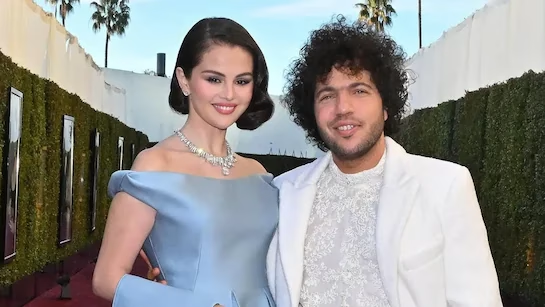
Selena Gomez has revealed the extraordinary lengths husband Benny Blanco went to in order to spend her birthday with her while she was working in London.
Because Blanco avoids flying, the music producer chose a very different way to cross the Atlantic: he traveled by ship.
Gomez described the journey as incredibly romantic — but admitted that waiting for her husband to complete the ocean crossing was also stressful.
The trip came while Gomez was in the United Kingdom working on Only Murders in the Building, adding another memorable chapter to the couple’s first year of marriage.
Why Benny Blanco Sailed to London Instead of Flying
Blanco has a fear of flying, which makes international travel more complicated than it is for most Hollywood couples.
Rather than missing Gomez’s birthday while she was working overseas, he chose to make the transatlantic journey by sea.
Gomez told People that she appreciated the romantic gesture but worried about Blanco’s safety while he was traveling.
Blanco has since revealed that traveling across the Atlantic by ship isn’t a one-time experience. He said he has made the crossing multiple times while Gomez has been working in London.
For Gomez, the unusual arrangement has become part of their life together.
Selena Gomez Was Working in London
The actress was in the U.K. working on the sixth season of Only Murders in the Building when Blanco made the journey.
Gomez has starred as Mabel Mora alongside Steve Martin and Martin Short since the Hulu comedy premiered.
Her London work schedule meant the couple had limited time together, but Blanco’s arrival gave them an opportunity to celebrate Gomez’s 34th birthday.
They were able to spend several days together before taking a short trip to Tuscany, Italy.
Gomez described the getaway as a rare opportunity to relax, eat plenty of Italian food, and spend uninterrupted time with her husband.
Selena Gomez and Benny Blanco Are Approaching Their First Anniversary
The trip came during an important year for the couple.
Gomez and Blanco married on September 27, 2025, and are preparing to celebrate their first wedding anniversary.
Speaking about married life, Gomez said their relationship still feels like it is in the honeymoon stage.
She credited Blanco with being an attentive and supportive partner who meets her where she is emotionally.
Gomez has also said that Blanco’s personality has encouraged her to overthink less and become more confident.
Benny Blanco’s Fear of Flying Has Led to Some Unusual Trips
Blanco’s decision to sail to Europe might sound extreme, but traveling by sea has become a practical alternative for the producer.
He recently discussed making repeated Atlantic crossings in order to spend time with Gomez while her work takes her overseas.
Blanco said he has completed the transatlantic trip by ship numerous times.
For two people with demanding careers in entertainment, that requires some unusual scheduling.
Gomez continues to balance acting, music, producing, and her Rare Beauty business, while Blanco has spent years producing and writing music for major recording artists.
Their travel arrangements highlight a familiar challenge for people working in film, television, and music: productions can require extended periods away from home.
Selena Gomez Says Her Life Has Become More Balanced
Gomez also reflected on how her attitude toward work has changed as her career has evolved.
Earlier in her career, she said she often felt most fulfilled when she was constantly working.
Now, she has become more deliberate about appreciating time away from a set or recording studio.
The actress described her current life as more peaceful and said she has found a better balance between professional commitments and her personal life.
That perspective is particularly relevant in an industry known for unpredictable schedules, long production days, travel, and periods of intense work.
What Entertainment Professionals Can Take From Gomez’s Story
For actors and other entertainment professionals, Gomez’s comments touch on an issue that receives less attention than auditions, bookings, and career milestones: maintaining a personal life around production schedules.
Film and television jobs can require performers to temporarily relocate, spend months on location, or work schedules that change quickly.
Those opportunities can be exciting, but they can also affect relationships and everyday routines.
Gomez and Blanco’s unusual travel arrangement is an extreme example, but the underlying challenge is familiar throughout the entertainment industry.
For working performers, planning for location shoots and extended production periods can become just as important as preparing for the role itself.
Selena Gomez Continues ‘Only Murders in the Building’
Gomez’s work on Only Murders in the Building remains a major part of her acting career.
Since its debut, the mystery-comedy series has become one of her most recognizable screen projects, pairing Gomez with veteran comedy performers Steve Martin and Martin Short.
The series has also expanded Gomez’s work behind the camera through her role as an executive producer.
Her current production commitments show how a successful television series can involve much more than the days audiences eventually see on screen.
For actors, long-running shows can mean returning to the same character for years while balancing travel, press appearances, other productions, and personal commitments.
For Gomez, one of those commitments happened to involve waiting for her husband to cross an ocean.
Frequently Asked Questions
Why did Benny Blanco take a boat to London?
Benny Blanco avoids flying because of his fear of air travel. When Selena Gomez was working in London around her birthday, he crossed the Atlantic by ship so they could spend time together.
Did Benny Blanco really sail across the Atlantic for Selena Gomez?
Yes. Blanco traveled across the Atlantic by ship to visit Gomez while she was working in the U.K. He has also said he has made the transatlantic journey by boat multiple times.
Why was Selena Gomez in London?
Gomez was working in the United Kingdom on Only Murders in the Building when Blanco traveled to meet her. Recent coverage identifies the production as Season 6 of the series.
How did Selena Gomez feel about Benny Blanco’s boat trip?
Gomez said she considered the gesture romantic but also found it stressful because she worried about Blanco while he was traveling across the Atlantic.
Are Selena Gomez and Benny Blanco married?
Yes. Gomez and Blanco married on September 27, 2025, and are approaching their first wedding anniversary.
How old is Selena Gomez?
Selena Gomez is 34 as of September 2026.
What show is Selena Gomez currently working on?
Gomez continues to star in Only Murders in the Building, where she plays Mabel Mora alongside Steve Martin and Martin Short.
What has Selena Gomez said about married life?
Gomez has said that she and Blanco still feel as though they are in their honeymoon stage. She has praised him for being supportive, joyful, and encouraging her to overthink less.
Where can actors find film and TV casting calls?
Actors can use Project Casting to discover casting calls, auditions, television roles, movie opportunities, and other entertainment jobs. Following productions and industry news can also help performers understand where new casting opportunities may develop.
Kit Harington is heading from Westeros to Hogwarts — and the Game of Thrones star says one major reason convinced him to join HBO’s highly anticipated Harry Potter television series.
Harington, who will play Gilderoy Lockhart in the show’s second season, revealed that his decision came down to something simple: he has been a devoted Harry Potter fan for years.
During an appearance on TODAY, Harington explained that the books were important to him as a child and became part of his life again as an adult.
The actor said he now listens to the stories regularly and was immediately interested when he learned HBO was developing a television adaptation.
For Harington, the longer format offers something the original movies could not always provide — more time to explore the books in detail.
Why Kit Harington Wanted to Join ‘Harry Potter’
Harington described himself as a lifelong fan of J.K. Rowling’s novels.
He first discovered the series when he was younger before returning to it as an adult, eventually making the audiobooks part of his nightly routine.
That personal connection made HBO’s adaptation particularly appealing.
Harington said he loves the original movies but believes television gives the creative team more room to explore characters, storylines, and moments from the books that could not fit into feature-length adaptations.
Speaking about the opportunity, Harington said the prospect of seeing the books explored more fully was especially exciting to him as a fan.
He also made it clear that he actively wanted to be involved rather than simply accepting another franchise role.
Kit Harington Will Play Gilderoy Lockhart
Harington has been cast as Professor Gilderoy Lockhart, the flamboyant celebrity wizard who becomes Hogwarts’ Defense Against the Dark Arts professor during Harry Potter and the Chamber of Secrets.
Kenneth Branagh famously played Lockhart in the 2002 movie adaptation starring Daniel Radcliffe, Rupert Grint, and Emma Watson.
Harington will introduce a new interpretation of the character when HBO reaches the second book in its television adaptation.
The casting also creates an interesting shift for audiences accustomed to seeing Harington as the serious and battle-hardened Jon Snow on Game of Thrones.
Lockhart is almost the opposite.
The character is theatrical, self-promotional, charming, and convinced of his own celebrity — qualities that could give Harington an opportunity to showcase a more overtly comedic side of his acting.
Harington has also previously voiced Lockhart for Audible’s full-cast Harry Potter audio production, giving him prior experience with the character.
The ‘Harry Potter’ Series Has Faced Debate and Backlash
Harington’s casting comes as HBO’s new adaptation continues to generate significant discussion.
Some criticism surrounding the franchise has focused on author and executive producer J.K. Rowling’s public statements on transgender issues, while other fans have questioned whether the popular film franchise needed to be adapted again so soon.
When discussing his decision to participate, Harington focused primarily on his longstanding affection for the books and his enthusiasm for what a television format could accomplish.
The actor said he saw the television adaptation as an opportunity to explore the original material in greater depth.
‘Harry Potter’ Season 2 Will Adapt ‘Chamber of Secrets’
The second season is expected to adapt Harry Potter and the Chamber of Secrets, the second novel in the original seven-book series.
That is where audiences first meet Lockhart.
The season is also adding several characters who become important as Harry, Ron, and Hermione continue their lives at Hogwarts.
Current Season 2 casting includes Rafe Spall as Arthur Weasley, Molly Hewitt-Richards as Moaning Myrtle, Jasper Ambrose as Colin Creevey, and Harington as Lockhart.
Dominic McLaughlin stars as Harry Potter, Alastair Stout plays Ron Weasley, and Arabella Stanton takes on the role of Hermione Granger.
The three young performers were selected following an extensive casting search led by casting directors Lucy Bevan and Emily Brockmann.
HBO Is Building a New Generation of ‘Harry Potter’ Stars
One of the most closely watched aspects of HBO’s Harry Potter adaptation has been its casting.
Alongside its young newcomers, the production has assembled an established group of actors to portray Hogwarts professors and other major characters.
John Lithgow plays Albus Dumbledore, Janet McTeer portrays Minerva McGonagall, Paapa Essiedu plays Severus Snape, and Nick Frost takes on Rubeus Hagrid.
For actors following the production, the project demonstrates how large franchise adaptations often combine established performers with emerging talent.
That creates opportunities across very different career levels — from internationally recognized actors such as Harington to young performers receiving their first major screen roles.
What Actors Can Learn From Kit Harington’s Casting
Harington’s decision to pursue Lockhart also highlights something important about building an acting career: a successful role does not mean an actor has to keep playing the same type of character.
Harington became internationally recognized through Game of Thrones, where Jon Snow was defined by seriousness, responsibility, conflict, and heroism.
Gilderoy Lockhart presents a dramatically different acting challenge.
For performers, taking roles that contrast with previous work can be one way to demonstrate range.
Casting directors already know what established actors can do based on previous performances. A very different character can give audiences and filmmakers an opportunity to see another side of their abilities.
The same concept applies to emerging actors.
Building a reel that demonstrates different tones — comedy, drama, authority, vulnerability, or character work — can help casting professionals understand an actor’s range.
Being a Fan Can Help an Actor Understand the Material
Harington’s comments also demonstrate the potential value of having a genuine connection with source material.
Actors do not need to be lifelong fans of every project they audition for, but familiarity with the material can provide useful context.
Understanding a story’s tone, world, relationships, and audience can inform performance choices.
For Harington, his familiarity with Harry Potter appears to have made the project particularly meaningful.
He was not simply interested in joining another major television franchise. He had already spent years engaging with the stories and specifically wanted to participate in HBO’s expanded adaptation.
When Does HBO’s ‘Harry Potter’ Premiere?
HBO has announced that the eight-episode first season, titled Harry Potter and the Philosopher’s Stone, will premiere on Christmas Day 2026 on HBO and HBO Max.
The first season introduces McLaughlin as Harry, Stanton as Hermione, and Stout as Ron as the characters begin their first year at Hogwarts.
Harington’s Gilderoy Lockhart will enter the story during Season 2.
For one of television’s most recognizable fantasy actors, the role represents another trip into a massive fictional universe — only this time, Harington says he already knows the world extremely well.
Frequently Asked Questions
Is Kit Harington in HBO’s ‘Harry Potter’ series?
Yes. Kit Harington has joined HBO’s Harry Potter television series and will appear beginning in Season 2.
Who is Kit Harington playing in ‘Harry Potter’?
Harington will play Professor Gilderoy Lockhart, the celebrity wizard who becomes the Defense Against the Dark Arts teacher at Hogwarts during Harry Potter and the Chamber of Secrets.
Why did Kit Harington join ‘Harry Potter’?
Harington said he has been a lifelong fan of the Harry Potter books. He was also excited by the opportunity for a television series to explore more of the novels than could be included in the original movies.
Has Kit Harington played Gilderoy Lockhart before?
Yes. Before taking the live-action HBO role, Harington voiced Gilderoy Lockhart in Audible’s full-cast Harry Potter audio adaptation.
Who originally played Gilderoy Lockhart?
Kenneth Branagh portrayed Gilderoy Lockhart in the 2002 film Harry Potter and the Chamber of Secrets.
Who plays Harry Potter in the HBO series?
Dominic McLaughlin plays Harry Potter. Arabella Stanton stars as Hermione Granger, while Alastair Stout plays Ron Weasley.
Who else is in the HBO ‘Harry Potter’ cast?
The cast includes John Lithgow as Albus Dumbledore, Janet McTeer as Minerva McGonagall, Paapa Essiedu as Severus Snape, and Nick Frost as Rubeus Hagrid, among many others.
When does the new ‘Harry Potter’ TV series premiere?
The first season of HBO’s Harry Potter series premieres on Christmas Day 2026 and will stream on HBO Max where the service is available.
What book will ‘Harry Potter’ Season 2 adapt?
Season 2 will center on Harry Potter and the Chamber of Secrets, which introduces Gilderoy Lockhart and several other characters joining the television adaptation.
Where can actors find TV and film casting calls?
Actors can use Project Casting to discover casting calls, auditions, television roles, movie opportunities, and entertainment industry news. Following major productions and understanding how professional casting decisions are made can also help performers prepare for future opportunities.
Brooke Shields’ “You’re Killing Me” Renewed for Season 2 at Acorn TV
Brooke Shields is returning to the world of small-town murder mysteries. Acorn TV has officially renewed “You’re Killing Me” for Season 2, bringing the mystery series back for another six episodes.
The renewal follows the show’s successful first-season launch, with Brooke Shields returning as celebrated author Allison “Allie” Chandler. Production on “You’re Killing Me” Season 2 is expected to begin later this year, making the project one for actors and entertainment professionals to watch as casting and production move forward.
What Is “You’re Killing Me” About?
“You’re Killing Me” is set in the picturesque community of Founder’s Cove, Maine, where small-town charm meets murder, secrets, and unexpected twists.
Brooke Shields stars as Allison “Allie” Chandler, a successful author who becomes involved in investigating the murder of a close friend. She teams up with aspiring podcaster Andrea “Andi” Walker, played by Amalia Williamson, to uncover the truth.
The series combines the familiar elements of a cozy murder mystery with comedy, character-driven storytelling, and the unusual personalities inhabiting Founder’s Cove.
Who Stars in “You’re Killing Me”?
Brooke Shields leads “You’re Killing Me” as Allie Chandler, while Amalia Williamson stars alongside her as Andi Walker.
Tom Cavanagh also stars as Kerrigan, the new lead detective of the local police department. A former city resident, Kerrigan finds himself adjusting to the quirks and personalities that come with small-town life while investigating crimes in Founder’s Cove.
The main cast includes:
Brooke Shields as Allison “Allie” Chandler
Amalia Williamson as Andrea “Andi” Walker
Tom Cavanagh as Kerrigan
The relationships between these characters provide a foundation for the mysteries, humor, and personal stories at the center of the series.
What to Expect From “You’re Killing Me” Season 2
“You’re Killing Me” Season 2 will consist of six episodes, continuing the format established by the first season.
Specific plot details for Season 2 have not yet been announced. However, the renewal means audiences will have another opportunity to return to Founder’s Cove and follow Allie, Andi, Kerrigan, and the other characters surrounding the community’s mysteries.
A new season may also introduce additional characters connected to future investigations, potentially including suspects, witnesses, residents, and other supporting roles.
Brooke Shields Reacts to the “You’re Killing Me” Season 2 Renewal
Brooke Shields celebrated the renewal and expressed her excitement about returning to work with series creator Robin Bernheim and co-stars Amalia Williamson and Tom Cavanagh.
Shields also thanked Acorn TV and the marketing and creative teams involved in bringing the series to audiences, while promising viewers more of what they enjoyed about the first season.
In addition to starring in “You’re Killing Me,” Shields serves as an executive producer on the series.
Why Acorn TV Renewed “You’re Killing Me”
The renewal comes after “You’re Killing Me” achieved a significant milestone for Acorn TV.
AMC Studios President Dan McDermott described the series as a breakout success and said it became Acorn TV’s No. 1 series launch of all time. He highlighted the show’s storytelling, twists, and Brooke Shields’ central role as factors behind its appeal to viewers.
The second season will give the creative team an opportunity to expand the world of Founder’s Cove while developing another mystery for its central characters.
Who Created “You’re Killing Me”?
“You’re Killing Me” was created by Robin Bernheim, who also serves as an executive producer.
The executive producing team includes:
Robin Bernheim
Brooke Shields
Christina Jennings
Scott Garvie
Michael Volpe
Dan March
The production brings together experienced television creatives, with Shields contributing to the project both in front of and behind the camera.
Who Are the Casting Directors for “You’re Killing Me”?
Casting is an essential part of building the fictional community of Founder’s Cove and finding the performers who bring its residents, suspects, witnesses, and other characters to the screen.
Sadie Connolly is among the casting professionals associated with “You’re Killing Me.” According to the provided professional profile, Connolly works in the casting department and has additional crew experience, with credits including “Sterling Point,” “Dreams of the Moon,” and “Bishop.”
TMH Management is also involved in casting for the project.
With “You’re Killing Me” returning for another six episodes, actors interested in appearing in the series should watch for verified casting announcements as production preparations continue. New episodes of a mystery series can require a variety of supporting, day-player, featured, and background characters depending on each storyline.
Acorn TV “You’re Killing Me” Season 2 Casting Call for New Talent
Upscale Restaurant Talent for “You’re Killing Me 2”
Job Description
“You’re Killing Me 2” is seeking upscale, wealthy-looking talent for a restaurant scene filming in Hamilton. This non-union background casting call is looking for performers with polished appearances, attractive on-camera presence, and high-end wardrobe suitable for an upscale dining environment.
Job Responsibilities
Portray bartenders, diners, and waitstaff in an upscale restaurant scene.
Perform naturally as a background actor in a professional production.
Bring a polished and sophisticated presence to the scene.
Follow direction from the production team while filming.
Maintain professionalism throughout the production.
Requirements
Non-union and AABP talent only.
Seeking one good-looking male bartender.
Seeking one very upscale male diner.
Seeking one attractive female waitress.
Seeking two attractive male waiters.
Must have appropriate upscale wardrobe.
Must be able to work in Hamilton.
New faces are encouraged.
Compensation
Compensation details will be discussed with selected talent.
When Will “You’re Killing Me” Season 2 Begin Production?
Production on the six-episode second season of “You’re Killing Me” is expected to begin later this year.
An official Season 2 premiere date has not yet been announced.
As the production moves closer to filming, additional information could emerge regarding filming locations, new cast members, guest stars, and casting opportunities.
Could “You’re Killing Me” Season 2 Bring New Casting Opportunities?
With another season entering production, “You’re Killing Me” is a project worth following for actors and entertainment professionals.
Television productions can require performers beyond their established principal cast, including supporting actors, guest stars, day players, background actors, stand-ins, and photo doubles. The specific needs for “You’re Killing Me” Season 2 will depend on the scripts and production requirements.
Actors should rely on verified casting notices for details about available roles, eligibility requirements, locations, compensation, and application instructions.
Stay Updated on “You’re Killing Me” Casting Calls
With “You’re Killing Me” Season 2 officially moving forward at Acorn TV, Brooke Shields will return for another chapter of mysteries in Founder’s Cove.
For actors, models, filmmakers, and other entertainment professionals, Project Casting makes it easier to discover opportunities connected to upcoming television shows, movies, commercials, and other productions.
Looking for “You’re Killing Me” casting calls, acting auditions, and other entertainment jobs? Stay connected with Project Casting for the latest casting news and opportunities.
Apply now on Project Casting and find your next opportunity.
Voice acting and modeling are two of the most accessible on-camera and behind-the-mic gigs in entertainment — and two of the hardest to price. Pay swings wildly depending on the job type, the market, whether the work is union, and how (and how long) the client’s voice or image gets used.
This guide gives you realistic, clearly-labeled market ranges for both fields so you can quote confidently, spot a lowball offer, and know which gigs are actually worth your time.
Important: none of these figures are official or fixed. They’re typical ranges drawn from commonly cited market data. Every job is negotiable, and your rate will depend on experience, market, and usage. If you’re unsure where you land in a range, widen it and quote toward the upper half — it’s easier to negotiate down than up.
[INTERNAL LINK: how to find casting calls for voiceover and modeling work — target page description: beginner’s guide to getting started on casting platforms]
Part 1: Voice Actor Pay Rates
Voiceover work splits into two income streams: the session fee (what you’re paid to record) and usage (what you’re paid for how the recording is used). Understanding the split is the single most important thing in this section — it’s where most beginners leave money on the table.
Commercial Voiceover
Commercial VO — TV, radio, online ads, pre-roll — is the best-paid bread-and-butter work in voiceover, and the session fee is only half the story.
Typical session range: most non-union commercial voice actors charge roughly $250–$1,000+ per session, depending on the market and the spot’s reach.
Local radio or streaming spot: often lands in the $250–$400 range for the session.
Regional or national broadcast: $500–$1,000+ per session is common for established talent.
Where the real money is: usage. A session fee gets you into the booth; usage (also called “buyout” or “licensing”) pays you for where the spot airs and for how long. A local radio ad running three months might include a modest usage fee baked into the session rate, while a national TV spot running a year can pay multiples of the session fee in usage alone. Always quote session + usage separately, and always get the usage terms (media, territory, duration) in writing before you record.
Animation and Video Games
Animation (TV, streaming, feature): union sessions typically run around $1,000+ per session for lead/character work on a TV episode; non-union animation commonly falls in the $250–$600 per session range depending on the project and role size.
Video games: most game VO pays roughly $250–$600 per hour of recording for non-union work. Union game sessions (under the SAG-AFTRA Interactive Agreement) start around $1,000+ per session day.
Game work deserves a warning: shouting, battle cries, and creature sounds are vocally demanding. Experienced game actors build vocal-protection time into their schedules — and into their quotes.
Audiobooks: Per Finished Hour
Audiobooks pay by the finished hour — one hour of finished audio, not one hour of your time. A finished hour typically takes 3–6 hours of recording and editing, so do the math before you accept a rate.
Typical range: most audiobook narrators charge roughly $200–$400 per finished hour.
Royalty-share deals: some publishers offer no upfront pay and split royalties instead. This is a gamble — fine as a calculated bet on a bestselling author, risky for an unknown title.
For a 10-hour audiobook at $300 PFH, that’s $3,000 — but expect 30–60 hours of real work behind it. Price accordingly.
E-Learning and Corporate Narration
The corporate world pays well for voices and rarely negotiates hard, which makes e-learning and corporate narration one of the steadiest income sources in VO.
E-learning: typically around $300–$600 per finished hour, though many narrators quote per module or per project ($400–$1,000+ per project for mid-length courses).
Corporate narration (internal videos, explainers, onboarding): roughly $400–$1,000 per project depending on length and script complexity.
Because corporate clients care more about reliability than rock-bottom prices, this category is a strong one for newer voice actors to target while building their demo reel.
[INTERNAL LINK: how to make a voiceover demo reel — target page description: guide to recording a competitive VO demo]
Union vs. Non-Union: How It Changes Pay
Union membership (SAG-AFTRA in the US) sets minimums — guaranteed floors, not ceilings. For example, union minimums run roughly $1,000+ per TV commercial session and around $1,082 for a TV animation session over 10 minutes. Union work also brings residuals (repeat payments when spots re-air) and pension/health contributions.
Non-union work has no floor, which cuts both ways: you can book more jobs with less competition, but you have to set and defend your own rates. The practical move for non-union talent: use union minimums as your reference point when negotiating, and never let a client treat non-union status as a discount on your quote.
How Usage and Buyouts Affect Pay
Three terms every voice actor should have locked down:
Usage: payment for where the spot runs (TV, radio, streaming, social), the territory (local, regional, national, worldwide), and the duration (3 months, 6 months, 1 year, in perpetuity). Broader usage = higher pay. Always renew usage in writing if a client wants to keep running the spot past the original term.
Buyout: a one-time payment covering the recording for a defined period or forever. A “full buyout” (paid once, used forever) should command a serious premium — many actors quote 2–4x the session fee, sometimes more for national broadcast.
Session fee: the base payment for your time in the booth, regardless of what happens to the recording afterward. Quote this separately from usage so the client can’t blur the two.
Red flag: any contract that pays a flat session fee and asks for unlimited usage in perpetuity. That’s a buyout priced as a session fee — quote it like a buyout or walk.
Part 2: Modeling Pay Rates
Modeling pay runs on day rates (or half-day rates) plus usage for commercial work. Like voiceover, the headline number is the day rate — but for print and commercial jobs, usage can add significantly on top.
Commercial and Print Modeling
This is the best-paid mainstream modeling category: catalogs, lookbooks, e-commerce, print ads, and commercial campaigns.
Typical day rates: most commercial/print models earn roughly $200–$1,500+ per day, with the range driven by job type and market.
E-commerce and catalog (regional markets): often $200–$500 per day.
National print campaigns or commercial shoots (LA/NYC): $800–$1,500+ per day is typical for experienced talent, and major campaigns pay more once usage fees are added.
For commercial jobs, always ask about usage: a day rate covers your time on set, but if your image runs in a national campaign for a year, usage fees are standard on top of the day rate.
Runway and Fashion Shows
Runway pays less than most people expect, and many emerging designers pay little or nothing — models take these jobs for exposure and portfolio material, not income.
Typical range: roughly $150–$500 per show for standard runway work.
Major fashion weeks / established designers (LA, NYC, Miami): $500–$1,000+ per show for experienced runway talent.
Treat unpaid or low-paid runway as a portfolio investment with a clear limit: a few prestige shows build your book; a year of free shows is just free labor.
Fit Modeling
Fit models try on clothing so designers can check sizing and construction — it’s steady, behind-the-scenes work with regular hours, and it pays well relative to the glamour level.
Typical range: roughly $150–$400 per hour for experienced fit models in major markets; sessions are usually booked in multi-hour blocks, so a full day can exceed $1,000.
Fit modeling values consistency over look: reliable measurements, punctuality, and the ability to give useful fit feedback matter more than editorial edge.
What Actually Moves Your Rate
Four variables drive modeling pay more than anything else:
Market. LA, NYC, and Miami pay meaningfully more than regional markets — typically 30–100% more for comparable jobs. Working in a major market, or traveling to one for booked work, is one of the fastest ways to raise your day rate.
Experience and book. A strong portfolio lets you quote the top of every range. New models in a major market often start at the bottom of the range and climb within a year or two of consistent bookings.
Job type. Commercial and fit modeling pay the best; runway and editorial pay less but build the portfolio that unlocks commercial work.
Usage. For print and commercial jobs, negotiate usage separately from the day rate. A national campaign running a year can double or triple your total pay through usage fees — or cost you nothing extra if you sign it away unknowingly.
[INTERNAL LINK: how to build a modeling portfolio — target page description: guide to creating a competitive model portfolio and comp card]
Avoiding Modeling Scams
Modeling is one of the most scam-targeted industries in entertainment. The rules are simple and absolute:
Never pay upfront fees to an agency or “casting director.” Legitimate agencies earn commission from your booked work (typically 15–20%) — they do not charge you to sign, to be listed, or to be “considered.” Anyone asking for a registration fee, portfolio fee, or “guaranteed placement” payment is running a scam.
Never pay for mandatory photo shoots with a specific photographer. A real agency may suggest photographers, but it won’t require you to pay their in-house shooter to be represented.
Verify the agency. Check that the agency has a real office, real clients, and a real roster. Search the agency name plus “scam” or “complaint” before signing anything.
Read every contract. Especially the sections on exclusivity, commission rates, and how long the agency controls your bookings. If anything is unclear, have someone experienced review it before you sign.
One legitimate upfront cost exists: your own portfolio photos from a photographer you choose. That’s your investment, not a fee paid to an agency.
FAQ
How much do beginner voice actors make per hour?
Most beginners booking non-union work charge roughly $150–$300 per hour for basic narration or small commercial jobs, with rates climbing as demos and credits build. Beginners should avoid racing to the bottom — underpricing early sets a ceiling that’s hard to raise later.
What is a per finished hour (PFH) rate?
A PFH rate pays you for each hour of completed, delivered audio — not the hours you spent recording and editing it. One finished hour typically takes 3–6 hours of total work, so a $300 PFH rate works out to roughly $50–$100 per actual hour of labor.
How much do models get paid per day?
Typical modeling day rates run roughly $200–$1,500+ depending on the job type and market. E-commerce and catalog work in regional markets sits at the lower end; national commercial campaigns in LA or NYC sit at the upper end, with usage fees on top for print and commercial jobs.
Do models or voice actors make more money?
It depends on the category. Top commercial voice actors and top commercial models both earn well into six figures; at the entry level, both typically land in the low hundreds per gig. Voiceover tends to offer steadier volume (e-learning, corporate narration), while modeling’s highest paydays come from commercial campaigns with usage fees.
Should I join SAG-AFTRA as a voice actor?
Joining makes sense once you’re consistently booking work that could be union, since it guarantees minimums, residuals, and benefits. But union membership means you can’t take non-union jobs, so most actors wait until their income and booking volume justify the switch.
Find Voiceover and Modeling Gigs on Project Casting
Knowing the rates is step one — booking the work is step two. Project Casting is a marketplace for TV, film, and advertising productions where voiceover artists and models browse real casting calls and apply directly. Browse the latest voiceover and modeling gigs, submit your demo or portfolio, and start booking work at rates you actually deserve.
UGC creator pricing is one of the most Googled questions in the creator economy — and one of the most confusing. One creator charges $100 per video. Another charges $1,000 for the same deliverable. Brands don’t know what’s fair, and new creators don’t know what to charge without either underselling themselves or pricing themselves out of work.
Here’s the honest answer: there are no official UGC rate cards. No governing body sets prices. Every number below is a typical market range drawn from what creators commonly charge and what brands commonly pay in 2026. Use them as a compass, not a contract — actual rates vary by creator experience, niche, complexity, brand budget, and (most importantly) usage rights.
UGC (user-generated content) is brand-directed content created by an independent creator that looks and feels like a real customer’s content — product demos, unboxing videos, testimonials, day-in-the-life clips — but is owned and published by the brand, not the creator. The creator is hired for their production skills and authenticity, not their audience.
That distinction is the whole pricing model:
UGC Creator
Influencer
What the brand pays for
The content itself (deliverables)
Access to the creator’s audience
Where it’s posted
Brand’s channels and ad accounts
Creator’s channels
Follower count matters?
Mostly not — brands buy the asset
Yes — reach drives the fee
Typical per-video range
$100–$500 for a single video
$1,000–$10,000+ for a 500K-follower post
This is why UGC rates are structured around deliverables and usage rights rather than follower counts. A brand paying $300 for a UGC video isn’t paying for impressions — it’s paying for a video asset it can run as an ad. The money question isn’t “how many followers does she have?” It’s “where will this video run, and for how long?”
That said, follower count still plays a role — just not the way it does in influencer marketing. More on that below.
Typical UGC Rates by Deliverable (2026 Market Ranges)
These are typical ranges most creators fall into, based on current market data. A beginner with no portfolio sits at the low end; an experienced creator in a premium niche (beauty, skincare, tech, finance) sits at the high end or above.
UGC Video
The core product. A typical single UGC video — scripted or directed by the brand, shot at home, 15–60 seconds, delivered with captions and a clean edit — usually runs $100–$500.
Within that band, commonly cited tiers look like this:
Beginner creators (0–10 brand deals): $100–$200 per video
Experienced creators (10–50+ deals, proven ad performance): $200–$500 per video
Top-tier creators (100+ deals, niche authority, high-converting track record): $500–$1,500+ per video
Longer videos (60+ seconds), scripted dialogue, multiple scenes, or videos requiring the creator to write the script themselves all push toward the top of the range. Raw, unedited footage typically adds a separate fee.
Product Photos
Still-image deliverables are priced far lower than video, because the production lift is smaller. A typical photo set (5–10 edited images) runs $50–$250, with single hero shots around $25–$75 each. Product flat-lays, lifestyle shots, and styled scenes command more than simple white-background product shots.
Testimonial Clips
A testimonial is a short talking-head review clip (15–45 seconds) where the creator speaks to camera about their experience with a product. Typical range: $150–$400 per clip — slightly above a basic product video, because genuine-feeling testimonials outperform scripted reads in paid social, and brands know it. Creators who already genuinely use the product can charge a premium over creators faking enthusiasm.
Unboxing Videos
Unboxing is its own deliverable category: the creator films opening the product, reacting, and doing first impressions. Typical range: $150–$350 per video. The unscripted nature means less prep for the creator, but the authentic “first reaction” energy is exactly what converts, so prices hold up well. Some creators discount unboxings when the brand sends free product and pays — the product itself counts as partial compensation, but it doesn’t replace the fee.
Ad Creative Bundles
This is where experienced creators make their best margins. Instead of selling one video, they sell a package. Common bundle structures:
3 videos + 5 photos: typically $500–$900
5 videos (one month of creative): typically $1,000–$2,500
10 videos (always-on creative testing): typically $2,000–$4,000+
Bundles discount the per-video rate (that’s the point — brands buy volume), but they raise the total deal size and reduce the creator’s sales effort. If you’re a creator, package your rates: bundles make higher totals feel like better deals, and brands love one invoice instead of five.
[INTERNAL LINK: commercial casting guide — target page description: guide to commercial casting services for brands]
How Follower Count Affects UGC Pricing
Here’s the nuance the influencer world gets wrong: for pure UGC, follower count barely affects the creation fee. The brand isn’t buying your audience — it’s buying a video to run on its own channels. A nano creator with 2,000 followers and an iPhone can produce a $300 ad-ready video that’s identical in value to one from a creator with 100K followers.
But follower count still matters in three indirect ways:
Credibility signal. Brands use follower count as a proxy for “this person knows what they’re doing.” A creator with 50K followers quoting $500 feels safe; a creator with 300 followers quoting $500 raises eyebrows. Same deliverable, different perceived risk.
Whitelisting value. When a brand runs ads through the creator’s account (whitelisting), the creator’s audience becomes part of the product. Bigger engaged audiences = higher whitelisting fees. This is the one place follower count directly prices in.
Content quality correlation. Creators with larger audiences usually have more reps — better lighting, better hooks, better retention instincts. Brands pay for the skill, and follower count often (not always) correlates with it.
Typical per-post ranges by creator tier, as commonly cited across creator-economy benchmarks (these reflect blended UGC/influencer work, not pure UGC creation fees):
Nano (1K–10K followers): roughly $50–$300 per post
Micro (10K–50K followers): roughly $200–$800 per post
Mid-tier (50K–500K followers): roughly $800–$5,000 per post
If you’re buying pure UGC deliverables, ignore these tiers and price the asset. If you’re pricing whitelisted ad rights, weight them heavily.
Organic vs. Paid Usage: Where the Real Money Is
This is the section most rate guides bury and most beginners miss. Usage rights are where UGC money is actually made.
The creation fee pays for the labor of making the video. The usage fee pays for what the brand does with it. Those are two separate products, and experienced creators invoice them as two separate line items.
Organic use
The brand posts the content on its own social feeds (TikTok, Instagram, YouTube) without paid spend behind it. Most creators include organic use in the base price — the $100–$500 video fee typically covers the brand posting it organically, in perpetuity or for 12 months. Always define the term in the agreement anyway.
Paid use (ads)
The moment a brand puts paid spend behind your video — boosting it, running it as a Meta/TikTok ad, placing it in a paid campaign — the video becomes an ad unit generating revenue. That changes its value completely. A typical paid-usage add-on runs $200–$500 per video for 30–90 days of ad rights, scaled to spend and duration.
Whitelisting
Whitelisting (also called creator licensing or Spark Ads on TikTok) means the brand runs paid ads from the creator’s own account, borrowing their face, voice, and audience trust. Because the creator’s identity is the asset, whitelisting commands a premium: typical whitelisting fees run 30–100% of the base creation fee per month, or a flat $300–$1,500+ per month depending on the creator’s audience size and the ad spend behind it. High-spend campaigns ($50K+/month in ad spend) justify fees at the top of that range or beyond — the creator’s likeness is doing real commercial work.
Full buyout
A buyout means the brand owns the content outright — unlimited use, all channels, in perpetuity. Typical buyout add-ons: $1,000+ per deliverable on top of the creation fee, or 2–5x the base rate. Creators should price buyouts high because they foreclose all future licensing income from that asset.
The golden rule: always separate the creation fee from the usage fee in your quotes. One line for making it, one line for running it. If a brand wants paid usage later, you’re not renegotiating from zero — you’re activating a tier you already priced. This single habit is the difference between creators who earn $300 per deal and creators who earn $1,200 per deal on the same video.
[INTERNAL LINK: talent rates guide — target page description: guide to setting your rates as commercial and content talent]
Retainers vs. One-Off Pricing
One-off deals
One project, one invoice. Typical one-off video: $100–$500 plus usage. One-offs are how most creator-brand relationships start — a paid audition, essentially. Brands test creative performance; creators test whether the brand is easy to work with. Healthy, but unpredictable income.
Retainers
A retainer is a monthly agreement: the brand commits to a fixed volume of content (say, 5 videos/month) for a fixed monthly fee. Typical UGC retainers run $500–$5,000+ per month, scaling with volume, turnaround speed, and usage rights:
Small retainer (2–3 videos/month, organic use): roughly $500–$1,500/month
Mid retainer (5–8 videos/month, some paid usage): roughly $1,500–$3,000/month
Retainers discount the per-video rate — the brand is buying predictability and priority — but they stabilize a creator’s income and eliminate the constant pitching cycle. For brands, a retainer creator learns the product, the audience, and the winning hooks over time, so creative quality compounds. For creators, three retainer clients at $1,500/month beats chasing twelve one-offs.
Pricing tip for creators: quote retainers as a flat monthly package, not a per-video rate multiplied by volume. “$2,000/month for 6 videos, organic + 90-day paid usage included” is a cleaner sell than “$333/video × 6.” And build in a 30-day out clause — brands like low-commitment trials, and you’ll rarely get fired if the creative performs.
How Creators Package and Quote
Top-earning UGC creators don’t sell videos. They sell packages with tiers, and the structure is remarkably consistent:
1. A three-tier rate card. Every serious creator has one — often a one-page PDF or a section of their media kit:
Starter: 1 video, organic use — entry price
Growth: 3 videos + hooks/CTA variations, 90-day paid usage — the package most brands buy
Tiered pricing works because it anchors the negotiation. The brand sees the top tier, flinches, and “settles” on the middle — which is exactly the tier you priced to be your real offer.
2. Line-item add-ons. Raw footage (+$50–$150), extra hook variations (+$25–$75 each), rush delivery under 48 hours (+25–50%), scriptwriting (+$50–$100), additional revision rounds beyond two (+$25–$50). Add-ons turn a $250 base into a $450 invoice without the creator working twice as hard.
3. Usage as the upsell. The base quote covers organic. Paid usage and whitelisting are presented as upgrades, not demands. This keeps the headline price competitive while the real margin lives in the add-on tiers.
4. Portfolio over follower count. New creators: if you have no brand deals yet, make 5–10 spec videos for products you already own, post them publicly, and link them in every pitch. A creator with 200 followers and a portfolio of sharp spec work out-quotes a creator with 20K followers and no portfolio — because brands buy proof, not potential.
5. Raise rates every 10 deals. The standard pattern: start at $100–$150/video, raise by $25–$50 after every 5–10 completed deals as your portfolio and turnaround speed improve. Most established creators land in the $250–$500/video zone within their first year. The ones who don’t are usually the ones who never separated usage fees from creation fees.
Finding UGC Gigs That Pay Fair Rates
Knowing the rates is half the battle; finding brands that actually pay them is the other half. Marketplaces where brands post structured UGC briefs — with budgets, deliverables, and usage terms spelled out upfront — cut out the lowball DMs and the “exposure” offers. Project Casting is a marketplace for TV, film, and advertising productions where brands and productions post UGC and brand-deal gigs with real budgets attached, and talent can browse and apply directly.
When evaluating any gig, run this checklist before you quote:
What’s the exact deliverable list (video count, length, photos)?
Organic use only, or paid/whitelisting? For how long?
How many revision rounds are included?
Who writes the script — you or the brand?
Is the product gifted on top of the fee, or is the product instead of the fee? (Never accept product-only payment on a brand’s ad creative.)
FAQ
How much do UGC creators charge per video in 2026? Most UGC creators charge roughly $100–$500 for a single video, depending on experience, niche, and complexity. Beginners typically start around $100–$200; experienced creators with proven ad performance charge $300–$500+. These are typical market ranges, not fixed prices, and usage rights (paid ads, whitelisting) are usually priced separately.
Do UGC creators charge based on follower count? Mostly no — unlike influencer marketing, UGC pricing is based on deliverables and usage rights, not audience size, because the brand publishes the content on its own channels. Follower count matters mainly for whitelisting deals, where ads run from the creator’s account.
How much extra do creators charge for paid ad usage? A typical paid-usage add-on runs $200–$500 per video for 30–90 days of ad rights. Whitelisting (running ads from the creator’s account) usually costs 30–100% of the creation fee per month, or a flat $300–$1,500+ monthly depending on audience size and ad spend.
What is a typical UGC monthly retainer? Monthly UGC retainers typically run $500–$5,000+, depending on volume and usage rights. A small retainer (2–3 videos/month, organic use) is roughly $500–$1,500; an always-on creative partnership (10+ videos with paid usage and whitelisting) runs $3,000–$5,000+.
How should a beginner UGC creator set their rates? Start around $100–$150 per video with organic usage included, build a portfolio of 5–10 spec videos, and raise rates by $25–$50 every 5–10 completed deals. Always quote usage rights (paid ads, whitelisting) as a separate line item — that’s where the real earnings are.
Find Your Next UGC Gig on Project Casting
If you’re a creator ready to turn these rates into real deals, browse UGC and brand-deal gigs on Project Casting — brands post casting calls with budgets and usage terms upfront, so you can apply to the ones that pay what you’re worth. Create your talent profile, filter for UGC and brand-deal gigs, and start pitching today.
Commercial pay confuses almost every actor starting out. Here’s the core fact: the money you make on shoot day is usually only the beginning. A national spot can keep paying you for years after you leave the set — and in union work, the airplay money often dwarfs the day rate.
This guide breaks commercial pay into its three moving parts — session fees, holding fees, and residuals — then covers how the numbers shift for on-camera vs. voiceover, union vs. non-union, and buyouts vs. residuals. All figures below are typical market ranges for illustration only, not official union rate cards. Where a specific figure matters, SAG-AFTRA’s actual contract rates change periodically, so check the current agreement or ask your rep.
The Three Pieces of Commercial Pay
Every commercial contract, union or not, boils down to some version of these three components:
Session fee — pay for showing up and shooting.
Holding fee — pay for keeping you (and your face or voice) exclusive to the brand.
Residuals / usage fees — pay tied to the commercial actually airing, scaled by how widely and where it runs.
Confuse them and you can’t evaluate an offer. Separate them and everything clicks.
1. The Session Fee: Pay for the Shoot Day
The session fee is your base pay for being on set. Think of it as your day rate. Typical ranges:
Union on-camera session: roughly $700–$1,000 per session is a common ballpark for principals (these are illustrative ranges, not official rates — the actual scale moves with each contract cycle).
Non-union commercial day rates typically run $300–$1,000 for a shoot day, depending on the market, the brand, and whether the spot runs locally or nationally.
Union fitting fees: if the job requires a wardrobe fitting on a separate day, that’s typically paid as an additional session, not folded into the shoot day.
The session fee covers a defined workday (usually 8 hours for union commercial sessions). Overtime rules kick in after that — and yes, long commercial shoot days can meaningfully bump your check.
One comparison point for context: under the 2025–2026 SAG-AFTRA theatrical contract, a day performer earns $1,246/day. Commercial session fees sit in a comparable neighborhood for the shoot day itself — but commercials can add layers of usage money that film and TV day work doesn’t.
2. The Holding Fee: Pay for Exclusivity
Here’s the part most new actors miss. When you book a commercial, the brand doesn’t just buy your shoot day — it buys exclusivity. That means you generally can’t appear in a competitor’s commercial for the same product category (you can’t do the Ford spot if you just shot Toyota, for example).
The holding fee compensates you for that restriction. Key facts:
Holding fees are paid in 13-week cycles. Every 13 weeks the brand wants to keep you exclusive, they pay another holding fee — typically equal to a session fee.
The maximum period of use on union contracts is usually 21 months (roughly five 13-week cycles), though it varies by contract type.
If the brand doesn’t renew, you’re released — free to book competitors again.
Why this matters: even if a spot barely airs, a booked actor typically still collects session + holding fees for every cycle the brand holds them. That’s guaranteed money with no extra work beyond staying available and staying out of conflicts.
Holding fees also create the famous “conflict trap.” Book a small local car-dealership spot with a long hold and you may block yourself from a national auto campaign. Experienced commercial actors and agents weigh the holding terms, not just the day rate, before accepting.
[INTERNAL LINK: “how to cast a commercial” — step-by-step guide to casting commercial talent]
3. Residuals: Pay Every Time the Spot Airs
Residuals are the reason commercial acting can be so lucrative. They are payments for use — each time the commercial runs, in each market and on each medium, the performer gets paid.
In union commercial work, residuals are structured in 13-week cycles and scale with:
Market size — a national network airing pays far more than a single local market.
Medium — broadcast TV, cable, streaming/OTT, digital, and social are each priced differently.
Number of airings — more airings in a cycle means higher residual payments, often on a stepped scale.
In practice: a spot that airs nationally across broadcast and cable in a heavy cycle can pay several thousand dollars in residuals per cycle — on top of the session and holding fees. Run that for multiple cycles and one booking can add up to tens of thousands of dollars over its life. That is the “one national spot” story: the shoot day is a small fraction of the total.
Non-union jobs usually handle this differently. Instead of per-airing residuals, non-union contracts most often use a buyout (more on that below) — a flat fee for a defined period and defined usage. There are no residual checks in the mail; you negotiated it all up front.
On-Camera vs. Voiceover for Commercials
Same brand, same campaign, different jobs — and different pay scales.
On-camera principals typically earn the highest session fees, because their likeness carries the exclusivity burden. On-camera holding fees can be significant since the conflict is visual.
Voiceover talent generally earn lower session fees than on-camera principals — union radio and TV voiceover sessions are often a few hundred dollars per session as a rough ballpark — but strong voiceover artists stack volume: many sessions per week across multiple brands.
Radio vs. TV voiceover differs too: TV voiceover (the voice behind a picture spot) and radio voiceover have historically had different scales and use structures, so always check which contract applies.
One strategic note: voiceover holds are less restrictive than on-camera holds (your voice in a spot rarely blocks you from on-camera work for competitors), which makes voiceover a popular parallel income stream for on-camera actors.
[INTERNAL LINK: “voiceover casting guide” — how to find and book voiceover talent]
Union vs. Non-Union Commercial Pay
This is the biggest fork in commercial pay, and it changes nearly everything about the structure:
Union (SAG-AFTRA) commercial work:
Minimums are set by the contract — session, holding, and residual scales are defined, not negotiated from zero.
Residuals keep coming in 13-week cycles for as long as the spot runs and the brand keeps paying.
Pension and health contributions are paid on your behalf on top of your check.
Your agent’s commission is typically 10% on union work.
You get conflict protection, defined maximum use periods, and payment deadlines.
Non-union commercial work:
Everything is negotiated. Session fees, usage, holds, and buyouts are whatever you and the production agree to — so the range is much wider.
Instead of residuals, non-union jobs usually pay a buyout: one flat fee covering a defined period of use (e.g., “one year, broadcast + digital”). Once it’s paid, the spot can run without additional checks.
Non-union day rates typically run $300–$1,000+, but a big-brand national non-union buyout can reach several thousand dollars for the right usage package.
Agent commissions on non-union work are commonly 20% — roughly double the union rate — and some agents treat buyout/usage money separately, so read your agency agreement.
There is no union enforcing payment timelines or tracking airings, which puts the burden of negotiation on you.
The trade-off is real: union spots pay more over time and carry protections, but non-union work is far more plentiful, books faster, and is open to actors who aren’t yet SAG-AFTRA eligible. Many working commercial actors do both early in their careers — with a careful eye on conflicts.
Buyouts vs. Residuals: Which Is Better?
Residuals mean you get paid as the spot airs. Low risk for the brand, potentially high upside for you. The classic “gift that keeps on giving” — checks arrive in 13-week cycles for the life of the campaign.
A buyout is a single lump sum paid instead of residuals, covering a defined period and defined usage. The brand gets cost certainty; you get money up front but give up the upside.
Which is better depends entirely on the numbers. A generous buyout for limited usage can beat modest residuals; a small buyout for a national campaign that runs for years is a bad deal. When evaluating a non-union buyout, ask four questions:
What’s the usage? Which media, which markets, how many spots?
How long is the term? One year? In perpetuity? (Never accept “in perpetuity” cheaply — it means forever.)
What’s the conflict? What categories are you blocked from, and for how long?
Is the session fee separate? Make sure the day rate isn’t being swallowed by the buyout number.
Rule of thumb: the broader the usage and the longer the term, the bigger the buyout needs to be. A national TV buyout for two years should be a multiple of a local digital-only buyout for 13 weeks.
Why One National Spot Can Pay Far More Than the Shoot Day
Let’s put it together with a clearly labeled illustrative example — these numbers are made-up round figures to show the structure, not real rates:
Example: “Riley” books a national union on-camera spot
Component
Illustrative figure
Session fee (shoot day)
$800
Fitting session
$400
Holding fee (per 13-week cycle)
$800
Residuals, heavy national cycle
$2,500 per cycle
Now imagine the campaign runs well and the brand holds Riley exclusive and airs the spot for four 13-week cycles (about a year):
Session + fitting: $1,200 (one time)
Holding fees: $800 × 4 = $3,200
Residuals: $2,500 × 4 = $10,000
Illustrative total: $14,400 from a single shoot day
That’s the whole story of commercial pay: the shoot day was $800, but the usage structure turned it into $14,400. Not every spot runs nationally — a local spot might pay the session fee plus one holding cycle and stop there — but the structure is what creates the upside.
Flip side, non-union example: the same spot as a non-union booking might be offered as $1,200 for the shoot day plus a $3,000 buyout covering one year of national use. Total: $4,200, no more checks. Whether that’s fair depends on how widely the spot actually runs — which is exactly why the four buyout questions above matter.
What Gets Deducted Before You See the Money
The gross figures above aren’t what lands in your account:
Agent commission: ~10% on union work, ~20% on non-union work.
Union dues: SAG-AFTRA working dues are a percentage of earnings — small per check, but real.
Taxes: you’re typically paid as an employee (W-2) on union jobs; non-union work may be 1099, meaning you handle your own withholding.
Manager fees: if you have one, typically 10–15%.
A $1,000 union session check might net roughly $700–$750 after commissions, dues, and withholding. Budget accordingly.
How to Position Yourself for Commercial Work
Commercial casting moves fast and rewards a specific profile:
Keep your materials current. Commercial casting directors want recent headshots and a reel with commercial or lifestyle footage — not just theatrical clips.
Be bookable and conflict-free. Know which brands you’re currently held for before you audition, and disclose conflicts immediately.
Respond quickly. Commercial auditions and avail checks often have same-day or next-day turnarounds. Slow responses lose bookings.
Understand your worth before negotiating. If you know what session, holding, and residuals should look like for a given usage, you can spot a low buyout in seconds.
Background and extra work is a separate lane with its own pay structure — background actors earn a flat daily rate with no residuals, and the numbers are much smaller.
[INTERNAL LINK: “background actor pay guide” — what extras and background actors earn] [INTERNAL LINK: “how to get cast in a commercial” — audition and booking guide for talent]
FAQ
How much do commercial actors get paid on average? It depends on union status and usage. Union session fees are typically in the high hundreds of dollars per shoot day, and non-union day rates typically run $300–$1,000. But total earnings from one spot — session, holding fees, and residuals combined — can range from a few hundred dollars for a small local non-union spot to tens of thousands for a national union campaign.
What is a session fee in commercial acting? The session fee is the performer’s base pay for the shoot day (and for wardrobe fittings, which are often paid as separate sessions). It covers a defined workday, with overtime applying beyond it. In union work it’s set by contract minimums; in non-union work it’s negotiated.
What is a holding fee? A holding fee compensates the actor for exclusivity — the agreement not to appear in a competitor’s commercial during the hold period. It’s typically paid per 13-week cycle, often equal to a session fee, and continues as long as the brand keeps the performer under contract.
Do commercial actors get residuals? Union commercial actors do: residuals are paid in 13-week cycles based on how widely and where the spot airs. Non-union actors generally do not receive residuals; instead, non-union contracts typically use a buyout — a flat fee covering a defined period and defined usage.
Is it better to do union or non-union commercials? Union commercials pay more over time through residuals, include pension and health contributions, and carry contractual protections — but require SAG-AFTRA membership or eligibility. Non-union commercials are more plentiful and faster to book, pay through session fees and buyouts, and typically carry higher agent commissions (~20%). Many actors do non-union work while working toward union eligibility.
What’s the difference between a buyout and residuals? A buyout is a one-time flat payment that covers all usage for a defined period — no further checks. Residuals are ongoing payments tied to actual airings, paid in cycles for as long as the spot runs. Residuals favor the actor when a spot runs widely; a buyout favors the actor when the upfront number is strong and the usage is limited.
Looking for commercial work? Browse and apply to commercial casting calls on Project Casting — new on-camera and voiceover opportunities post daily. [INTERNAL LINK: “commercial casting calls on Project Casting” — talent-facing casting call listings]
How Much Do Background Actors Get Paid? Union vs Non-Union Rates Explained
Background acting is one of the most common ways people get their first paid on-set experience. You don’t need an agent, a résumé full of credits, or a union card to start. But the pay varies a lot depending on whether you’re working union or non-union, what kind of set it is, and what you’re asked to do during the day.
This guide breaks down the numbers in plain English: the current day rates, the pay bumps that can push your daily total higher, and how overtime works.
What Background Actors Actually Do
Background actors — also called extras — fill out the world around the principal cast. They sit at café tables, walk down streets, fill courtroom benches, dance at clubs, and play audience members. The job is to look natural, take direction quickly, and stay quiet and out of the way between takes.
It sounds simple, and the work itself usually is, but productions depend on reliable background actors. Showing up on time, matching your continuity (same clothes, same position, same activity across takes), and being easy to work with is what gets you rebooked — and what gets you hired as a stand-in or upgraded to a special-ability rate.
[INTERNAL LINK: how to get cast as a background actor — related guide on applying for extras casting calls]
SAG-AFTRA Union Rates vs Non-Union Market Rates
SAG-AFTRA background actor rates (contract period 07/01/2025–06/30/2026)
The union minimums for background actors under the SAG-AFTRA theatrical wage tables are fixed per day (an 8-hour day). For the contract period July 1, 2025 through June 30, 2026, the figures are:
General background actors: $224/day
Special-ability background actors: $234/day
Stand-ins / photo doubles: $262/day
Those are minimums, not maximums — a production can pay more. Union background work also comes with employer contributions to the SAG-AFTRA Health Plan, formal overtime rules, and meal penalties, which are covered later in this guide.
“Special ability” covers background work that requires a specific skill performed on camera — things like juggling, dancing, playing an instrument, or riding a bicycle through a scene. Stand-ins are the background actors who literally stand where the principal actors will stand while the crew sets up lighting and camera — and photo doubles physically resemble a principal actor and are filmed in shots where the actor isn’t needed.
Non-union background actor rates (market estimate)
Non-union background work pays less and varies by market. As a market estimate, non-union background actors typically earn $100–$200/day, depending on the city, the size of the production, and how urgently they need people.
Large markets like Los Angeles, New York, and Atlanta tend to be at the higher end of that range; smaller markets can be lower. Independent films, student projects, and web series sometimes pay less or offer deferred pay — those are the gigs where reading the listing carefully matters most.
The tradeoff is volume and access: non-union background work is far more plentiful, you don’t need a union card, and it’s where most people build their early credits before going SAG-AFTRA eligible or joining the union.
Pay Bumps Explained
Your base day rate isn’t always your final paycheck. Union productions pay “bumps” — additional per-day amounts — when the job requires extra effort, props, or conditions. Here are the most common ones, using the SAG-AFTRA theatrical union schedule figures (per day):
Props you bring or handle
Pets you bring to set: $23/day — you’re supplying the animal, so you’re paid for it.
Golf clubs with bag: $12/day
Skis and poles: $12/day
Bicycle: $12/day
Tennis racquet: $5.50/day
Camera (prop): $5.50/day
Luggage: $5.50 per piece
Vehicle bumps
Auto (your car used on camera): $37.50/day
Motorcycle: $37.50/day
Driving or supplying your own vehicle for a shoot is one of the most common bumps, and it adds up fast over a multi-day booking.
Condition bumps
Some conditions — getting wet, working in smoke, or performing in unusual physical circumstances — trigger day adjustments. These amounts vary by contract and era, but a common approximate range is $10–$15 per day for wet work or smoke, added to your base rate. (Exact figures differ across SAG-AFTRA agreements, so treat these as approximate, not official.)
Special skills
If the production asks you to perform a special skill on camera — swimming, skating, dancing, horseback riding, playing an instrument — you’ll typically be bumped to the special-ability rate ($234/day union) or paid an additional adjustment for the day. Make sure whatever skill is requested in the listing is what you actually perform, because the bump is tied to the work done.
Costume and makeup
Productions that require special costuming or makeup compensate you for the extra time and effort. For example, if you’re required to arrive with extensively styled hair or non-ordinary period makeup done at home per the producer’s detailed instructions, you may receive a day adjustment (an approximate range is $20–$35/day depending on the contract). Corsets, body makeup, and formal or period costumes carry their own adjustments in most union agreements.
The key point: always confirm any bumps in your booking paperwork. If a listing says “must provide own car,” the bump should show up on your pay stub — and if it doesn’t, that’s a question for the casting office or the payroll company, not something to shrug off.
Overtime Basics
Background acting runs on an 8-hour day. After that, overtime kicks in — and this is where a “simple” $224 day can become a much bigger paycheck.
The 8-hour day
A standard day is 8 hours of work at the straight-time day rate. In practice, film and TV days routinely run longer than 8 hours, so understanding what happens after hour 8 is essential.
How overtime is calculated (general mechanics)
Union overtime typically works on a tiered structure. The following describes the general mechanics — treat the multipliers as the standard pattern rather than exact contract language:
Hours 1–8: straight time (your day rate divided across the hours)
Hours 9–10: approximately 1.5x your hourly equivalent
Hours 11–15: approximately 2x your hourly equivalent
Beyond 15 hours: pay can escalate to as high as a full additional day’s pay per hour
To make it concrete: if your day rate is $224, your hourly equivalent is $28. A 10-hour day would be roughly the $224 base plus two hours at 1.5x ($42/hour each) — about $308 before bumps. A 12-hour day adds two more hours at 2x ($56/hour each), pushing you toward roughly $420. This is why background actors love long shoot days: overtime is where the real money is.
Non-union productions don’t have to follow these rules, and many don’t. Some non-union productions pay a flat day rate regardless of hours, some pay half-day or full-day flat fees, and some offer overtime informally. This is one of the biggest practical differences between union and non-union background work — and it’s worth asking about hours before you accept a non-union booking.
Meal penalties (the concept)
Union sets are required to feed you at set intervals — generally around every 6 hours from your call time. When the production runs late on a meal, it owes you a meal penalty: a fixed amount (often around $10 per missed meal period) paid on top of your wages for that day. Penalties typically stack in half-hour increments the longer the meal is delayed.
The practical effect: a set that misses a meal by two hours can add a meaningful amount to everyone’s paycheck. Non-union productions generally don’t pay meal penalties, though they almost always provide meals or a meal allowance on full-day shoots.
How to Find Background Work
Getting background work is mostly about volume and responsiveness. Here’s what works:
Register with background casting agencies. Casting directors who specialize in background (sometimes called “extras casting” or “background casting”) are the main source of work. Create profiles, upload current photos, and respond to booking requests fast — background is often booked with hours of notice.
Browse casting call marketplaces. Sites where productions post open background calls let you apply directly instead of waiting for a casting office to call you. Look for listings that state the rate, the shoot date and location, and what’s required (car, costume, special skill) so you can target the ones with the best pay.
Keep your photos current and honest. Background casting is almost entirely look-based. Post recent, accurate photos in natural light — headshot, full body — and update them when your look changes. Misleading photos get you sent home at check-in, which wastes everyone’s day and gets you dropped from rosters.
Be reliable. The background actors who get called back are the ones who arrive on time, follow instructions, and don’t complain. Many background actors book their best gigs — stand-in work, multi-day holds, series regulars’ scenes — simply by being easy to have on set.
Track your pay. Note the rate, bumps, hours, and meal times for every job. Union or not, you should be able to reconcile your paycheck against what was promised. Keep copies of vouchers and call sheets.
[INTERNAL LINK: background actor resume template — guide on building a background acting résumé]
Background gigs at all levels — union and non-union — get posted regularly, and new actors who stay active and responsive can work several days a week in busy markets.
FAQ
How much do background actors make per day?
SAG-AFTRA union background actors earn a minimum of $224/day (contract period 07/01/2025–06/30/2026), with special-ability background at $234/day and stand-ins/photo doubles at $262/day. Non-union background actors typically earn $100–$200/day as a market estimate, depending on the city and production.
Do background actors get overtime?
Union background actors get overtime after 8 hours, typically at 1.5x for hours 9–10 and 2x for hours 11–15, with steeper rates beyond that. Non-union productions aren’t required to pay overtime and often pay flat day rates.
What are pay bumps for background actors?
Pay bumps are extra per-day amounts for providing props, vehicles, or special conditions. Examples from the union schedule include $23/day for pets, $37.50/day for your car or motorcycle, $12/day for a bicycle or golf clubs, and $5.50/day for a tennis racquet or camera.
Do background actors get paid for meals?
Union sets must provide meals roughly every 6 hours, and pay meal penalties (often around $10 per missed meal) when meals run late. Non-union productions typically provide meals on full-day shoots but rarely pay penalties.
Can you make a living as a background actor?
It’s difficult to rely on background acting as a sole income in most markets — the work is inconsistent, especially non-union. But busy background actors in major production hubs who accept long days, overtime-heavy shoots, and multi-day bookings can earn meaningful supplemental income. Many use it as a stepping stone to stand-in work or speaking roles.
Ready to get on set? Browse and apply to background and extras casting calls on Project Casting — the marketplace where productions list open background gigs and hire talent directly.
How Much Do Actors Get Paid in 2026? Commercial vs TV vs Film Rates
Actor pay is one of the most searched — and most misunderstood — topics in the industry. Most pay guides you find online give you a single number, or worse, a number that stopped being true years ago. This one does neither. Below are the current 2026 union minimums from the SAG-AFTRA theatrical wage tables, plain-English explanations of how pay structures actually work, and clearly labeled market ranges for the categories where there’s no single official rate.
A Quick Note on Outdated Rates
You’ll find plenty of older articles that still quote the SAG-AFTRA day rate as $1,082/day. That figure was the official minimum for the contract period ending June 30, 2023. This guide uses the current 2026 rates — day performer minimum $1,246/day — from the contract period running July 1, 2025 through June 30, 2026.
How Actor Pay Actually Works
Before the numbers, you need the mechanics, because “how much do actors make” has no single answer. Pay depends on four things:
Union vs. non-union. SAG-AFTRA sets enforceable minimums for union productions. Non-union pay is negotiated per project and varies widely.
Day vs. week. Union performers hired for a single day earn a day rate; hired for five or more consecutive days, a weekly rate (which works out to less per day but guarantees the week).
Session vs. residuals. One-time fees (“buyouts”) are common in non-union and digital work. Union work often adds residuals — payments for reuse — which is where the real money can accumulate.
Role size. Background performers, day players, guest stars, and series regulars live in completely different pay tiers.
Film Actor Pay in 2026
SAG-AFTRA theatrical minimums (current)
These are the official floor — producers can pay more, never less:
Day performer: $1,246/day
Weekly performer: $4,326/week (five-day week; works out to roughly $865/day)
Stunt performer: $1,246/day
A “day player” — an actor booked for a single day or a few days with a speaking role — gets the day rate. Book for a full week and the weekly rate applies. Overtime, holiday pay, meal penalties, and travel bumps stack on top.
What actors actually make per film
Scale is the floor, not the ceiling. Unknown actors in union indies often work at scale. Recognizable names negotiate above it, and A-list salaries (tens of millions per film) are a separate universe entirely. Most working union actors on mid-budget features earn somewhere between scale and several times scale, depending on the role, their quote, and their agent’s leverage.
Low-budget and non-union film
Not every film pays full scale. SAG-AFTRA has low-budget agreements where day rates can be roughly half of scale (around $630/day under the low-budget theatrical tables). Non-union indie films typically pay $100–$500/day as a market estimate, and some defer payment entirely. Always read the contract terms on a casting notice before you apply — pay terms should be stated up front.
[INTERNAL LINK: “how to read a casting call” — target page description: guide to understanding casting notices and contract terms]
TV Actor Pay in 2026
TV pay runs on weekly schedules rather than daily ones for most contracts, and the mechanics differ by format.
Network and basic cable
A union day player (a small speaking role, sometimes called a “co-star” slot) generally earns in the low four figures per day — roughly aligned with the $1,246/day theatrical minimum, since many episodic contracts track near scale for short engagements.
Guest stars typically earn a fixed fee per episode. Market ranges run roughly $5,000–$15,000+ per episode depending on the network, the show’s budget, the role, and the actor’s quote. This is an approximate market range, not a union minimum.
Series regulars are negotiated per season and vary enormously — mid-five figures per episode on the low end to six and seven figures for established stars on hit shows.
Streaming
Streaming productions pay under the New Media agreements. Higher-budget streaming work generally tracks near traditional TV scale (roughly $4,000+/week for performers on qualifying productions, as a labeled approximate range). Lower-budget new media has its own lower tier — the special new media schedules set much smaller minimums for truly small productions. Streaming residuals exist but work differently than broadcast residuals, and they’re one of the most negotiated areas of current contracts.
Reality TV and unscripted
Reality performers are often not covered by SAG-AFTRA agreements, and pay varies drastically — from a few hundred dollars per day for background or minor roles in docu-style shows (market estimate) to negotiated fees for leads. Always check the contract type on the listing.
Commercial Actor Pay in 2026
Commercials are where the biggest gap exists between “a single day’s work” and “total earnings,” because of residuals and buyouts.
How commercial pay is structured
Session fee — what you’re paid for the shoot day(s). For a union on-camera principal, this is roughly in the low four figures per session (approximate market range; exact session fees depend on the contract and role).
Residuals — payments each time the commercial airs, based on market, frequency, and medium. A national network spot that runs heavily can generate residuals many times the session fee.
Buyouts — a flat fee instead of residuals. Common in non-union and digital work. A national non-union buyout might range roughly $1,000–$5,000+ for a single campaign, while regional or local buyouts can be a few hundred dollars (all market estimates).
Union vs. non-union commercials
Union commercial work (SAG-AFTRA commercials contract) pays a session fee plus residuals structured by usage — TV, digital, in-store, etc. Non-union commercials usually pay a flat session fee plus a usage buyout for a defined period (typically one year). The same one-day shoot can pay a few hundred dollars or tens of thousands depending on the contract and the buy.
This is also why commercial residuals can be the best paycheck in acting: a single national spot that runs for a year can earn an actor $20,000–$100,000+ in total compensation (approximate market range). On the flip side, many actors shoot national-quality spots that never air, and earn only the session fee.
Background Actor Pay in 2026
Background work (extras) is the entry point for many actors, and the rates are straightforward:
Union background: $224/day
Union special-ability background: $234/day (roles requiring a specific skill — swimming, skating, driving, etc.)
Union stand-ins and photo doubles: $262/day
Non-union background: typically $100–$200/day (market estimate)
Union background actors also get overtime after eight hours, meal penalties for late meals, and wardrobe fittings paid at an hourly rate. A 12-hour union background day with overtime can total roughly $300–$400+ (labeled estimate). Non-union background pay is often a flat day rate with no overtime premium, which is why a $150 non-union day and a $224 union day aren’t really comparable.
The Extras That Stack Onto Your Rate
Minimums are just the starting point. These additions apply across most union work:
Overtime — time-and-a-half after 8 hours, double after 16.
Meal penalties — paid when meals are served late, roughly $25 per half hour (approximate).
Travel and per diem — location work pays travel time, lodging, and a daily per diem.
Wardrobe bumps — additional pay for bringing your own wardrobe, hair, or makeup.
Pension & Health contributions — producers contribute an additional ~21.5% of earnings toward the SAG-AFTRA health and pension plans. This isn’t cash in your pocket today, but it’s real compensation.
So What Do Working Actors Actually Make Per Year?
Median annual acting income is much lower than the day rates suggest, because most actors don’t work every day. The math:
A union background actor working 50 days a year at $224/day grosses roughly $11,200 — before agent fees, taxes, and union dues.
A day player landing 20 union day-player days at $1,246/day grosses roughly $24,920.
A working guest-star actor booking a few episodic slots can clear $30,000–$60,000+ in a year (market estimate).
The gap between the day rate and the annual income is the hustle: auditions, bookings, dry spells, and competition. Actors who treat it as a business — tracking bookings, budgeting for dry months, and diversifying into commercial and background work — are the ones who make it sustainable.
[INTERNAL LINK: “how to become an actor with no experience” — target page description: beginner’s guide to starting an acting career]
Finding Gigs That Pay These Rates
Knowing the rates only helps if you can find the work. Every category above — union and non-union film roles, episodic TV, commercial sessions, and background calls — gets listed on Project Casting, the marketplace where TV, film, and advertising productions post casting calls and hire talent. Filter by role type, location, and pay to target the work that matches your goals, and apply directly.
FAQ
What is the SAG-AFTRA day rate in 2026? The SAG-AFTRA day performer minimum is $1,246/day for the contract period July 1, 2025 through June 30, 2026 (the previous minimum expired June 30, 2023).
How much do background actors make per day? Union background actors earn $224/day ($234/day for special-ability roles, $262/day for stand-ins and photo doubles), plus overtime and meal penalties. Non-union background work typically pays $100–$200/day as a market estimate.
How much do actors get paid per episode of TV? It depends on the role. Union day players earn in the low four figures per day; guest stars typically earn roughly $5,000–$15,000+ per episode as a market range; series regulars are individually negotiated and vary enormously.
Do actors get paid more for commercials than movies? They can. A single day shooting a commercial pays a session fee in the low four figures, but if the spot runs nationally, residuals or buyouts can push total earnings to $20,000–$100,000+ — sometimes more than a supporting film role at scale.
What is the difference between union and non-union pay? Union (SAG-AFTRA) work guarantees enforceable minimums — $1,246/day or $4,326/week for performers — plus overtime, residuals, and pension/health contributions. Non-union pay is negotiated per project with no minimums, and typically runs lower, though high-budget non-union work can pay competitively.
After 24 seasons in Los Angeles, American Idol is packing up and heading to the Atlanta area for Season 25. Fremantle, which produces the show alongside 19 Entertainment, confirmed the move to Deadline on September 15.
If you are an actor, a background performer, or a creator trying to get on television, this is not gossip. It is a signal. And it is one of the clearest of the year.
Here is the full picture: why Idol is leaving, what it tells you about where TV production is actually going, and what to do about it.
The Move, in Plain Terms
American Idol will film Season 25 — its tenth on ABC, premiering in the new year — in the Atlanta area instead of Los Angeles. Fremantle is in final talks with a studio complex there, though the deal is not signed yet.
The judges you know — Luke Bryan, Lionel Richie, and Carrie Underwood — are expected back, with deals still being worked out. Megan Michaels Wolflick continues as showrunner. The show filmed its most recent season at Red Studios in Hollywood, introduced social voting for the first time, moved Hollywood Week to Nashville, shifted to Monday nights, and started streaming live on Disney+.
None of that is why it is leaving. The reason is money — specifically, tax credits.
Why Shows Keep Leaving California
Georgia offers up to a 30% tax credit on unscripted and reality productions that spend at least $500,000 in the state. For a show with Idol’s budget, that is an enormous number. It is the same math that already brought Marvel productions like Captain America: Brave New World and WandaVision to Georgia, plus unscripted shows like Fox’s The 1% Club and ABC’s Press Your Luck.
California tried to fight back. Last year, legislators passed AB 1138, expanding the state’s film and television tax credit to cover certain unscripted productions for the first time. But the fine print tells the real story: only “large-scale competition shows” with minimum budgets of $1 million per episode qualify. Idol, on paper, looked like it fit — and reportedly did not qualify anyway. Traditional reality, game shows, talk shows, and docu-follow programming are excluded outright. Producers are frustrated, and more shows have been rejected.
The numbers explain the exodus. FilmLA reports that unscripted productions in Los Angeles logged 40% fewer shoot days in the second quarter of this year than in the same quarter of 2025. Over five years, LA reality production is down 62.7%.
Idol is not the first to go. Fox moved The Masked Singer to New Jersey for Season 15, drawn by 30% incentives on qualified expenses — up to 40% on certain studio projects — and the fact that New Jersey, unlike California, lets all types of unscripted shows qualify. Shark Tank went to Atlanta. Family Feud went to the Atlanta area. Lego Masters went to Atlanta.
This is not a trend anymore. It is a migration.
The Part Nobody Talks About: Casting Follows Production
Here is what the industry coverage misses, and what matters most if you are talent.
Every show that relocates drags hundreds of casting needs with it. Contestants, live studio audiences, background performers, stand-ins, featured extras, local hires for promotional shoots — a production the size of American Idol does not just need a soundstage. It needs people, in volume, on a schedule.
When production moves to Atlanta, the casting demand moves to Atlanta. The performers who are already there, already listed, and already reachable get the first calls. That is how this business has always worked: proximity plus readiness beats talent sitting in the wrong zip code.
Georgia’s film office reports 280 productions filmed in the state last fiscal year. Every one of those needed casting. The performers building careers in Georgia right now are not waiting for Hollywood to come back. They are standing where the work landed.
What This Means for You
If you are in Atlanta or elsewhere in Georgia: this is your window. A flagship network show landing in your market means more auditions, more background calls, and more chances to get network credits without leaving home. Make sure your casting profiles are current — headshots, reels, measurements, availability — because when the calls start, they go to the people who are ready first.
If you are in Los Angeles: do not panic, but do pay attention. Scripted production still has a deep base in LA, and 280 productions in Georgia does not erase that. But the unscripted side of the business is voting with its feet, and the 62.7% five-year decline is not a blip. If your career is built on reality, competition, game shows, or talk — the exact categories California’s credit excludes — you need a plan that includes working where those shows actually film now.
If you are anywhere else: the lesson is portable. Production follows incentives. Casting follows production. Your job is to follow the casting. That means being listed where productions look, keeping your materials sharp, and saying yes to markets you might have overlooked two years ago. Nashville got Idol’s Hollywood Week. Atlanta is getting the season. The map is being redrawn in real time.
The Bigger Picture for 2026 and Beyond
Step back and the pattern is unmistakable. States are competing for productions with real money — 30% here, 40% there — and productions are making rational decisions. California’s attempt to compete came with so many carve-outs that its biggest unscripted shows are leaving anyway. Until that changes, expect more announcements like this one.
For talent, the takeaway is simple and permanent: the center of gravity is moving. The performers who treat this like news to scroll past will keep waiting. The ones who treat it like a map will be in the room.
American Idol spent 24 seasons telling singers “you’re going to Hollywood.” Season 25’s winners will be going to Georgia. Go where the work is.
Looking for your next role? Browse current casting calls for TV, film, commercials, and background work — updated daily.
TL;DR: Toronto has five productions rolling in October. Lindsay Lohan and Henry Golding’s Netflix romance Return to You is on location now, Netflix’s This Summer Will Be Different wraps October 16, Heated Rivalry Season 2 is on soundstages through December 2, You’re Killing Me Season 2 shoots through November 12, and the new series Rules of Prey runs through December 16. Fall is Toronto’s deepest bench of the year.
What’s Filming in Toronto in October 2026
Return to You (Netflix). The romantic drama starring Lindsay Lohan and Henry Golding, directed by Mark Waters, is filming on location in Toronto — Lohan was photographed on set on October 1, 2026. A star-driven location feature means street-level production across the city and the background bookings that come with it.
This Summer Will Be Different — Season 1 (Netflix). The adaptation of Carley Fortune’s bestselling novel has been filming in Toronto since August 31 and wraps October 16, 2026. Sophie Nélisse, Roby Attal, and Francesca Reale star. A romance series shooting into the fall means beach-town and city scenes — and a final casting push as the production approaches its wrap.
Heated Rivalry — Season 2 (series). The hockey drama is filming on Toronto soundstages from August 17 through December 2, 2026. The cast includes Hudson Williams, Connor Storrie, François Arnaud, Christina Chang, Charlie Gillespie, and Justice Smith. Stage-based series are the steadiest background employers in the business — arena crowds, team staff, and recurring world-building roles across a four-month shoot.
You’re Killing Me — Season 2 (series). Filming in Toronto from September 14 through November 12, 2026, with Brooke Shields, Amanda Williamson, and Tom Cavanagh. A second-season series returning to the same city means the production already has its local machine built — casting calls draw on Toronto talent pools first.
Rules of Prey — Season 1 (series; working title B.C.A.). Showrunner Bruce Terris’s new series films in Toronto from September 14 through December 16, 2026 — the longest runway on this slate. First-season productions are where new recurring background rosters get built; getting in during the first month pays off across the whole shoot.
Why Toronto’s October Slate Works for Talent
The mix is the story: two Netflix productions, three returning or launching series, shoots ending in mid-October, mid-November, and mid-December. Staggered wraps mean casting calls don’t all land at once — they roll through the fall. And with four of the five productions shooting for weeks or months more, a booking this month can turn into recurring work through the holidays. Toronto’s combination of soundstage capacity and location range is exactly why streamers keep stacking slates here.
How to Get Cast on Toronto Productions
Keep a current Project Casting profile. Toronto casting teams search by location and availability. Current photos, accurate sizes, and up-to-date contact details are the baseline — a stale profile reads as unavailable.
Watch the casting calls board. Browse casting calls for Toronto productions and set alerts for background and extra work. This Summer Will Be Different wraps October 16, so its final calls are the most time-sensitive on the slate.
Target the long shoots.Rules of Prey runs through December 16 and Heated Rivalry through December 2. Early bookings on long productions put you in the recurring pool — the calls come to you instead of the other way around.
Fit the world of the show. Hockey crowds and arena staff for Heated Rivalry, romance-drama polish for Return to You — tailor your submission photos and wardrobe notes to the production you’re submitting to.
Be ready for stage days. Soundstage productions run controlled, early, and precise. Reliability — on time, in holding, off your phone — is what turns one stage day into a season of them.
FAQ
What is filming in Toronto in October 2026?
Netflix’s Return to You (Lindsay Lohan, Henry Golding) on location, Netflix’s This Summer Will Be Different Season 1 (through October 16), Heated Rivalry Season 2 (through December 2), You’re Killing Me Season 2 (through November 12), and Rules of Prey Season 1 (through December 16).
How do I get cast as an extra in Toronto?
Keep a current Project Casting profile, watch the casting calls board for Toronto background notices, and submit complete materials quickly — stage-based series like Heated Rivalry book recurring background rosters early in the shoot.
Which Toronto production films the longest? Rules of Prey — the new series shoots September 14 through December 16, 2026, with Heated Rivalry Season 2 close behind at August 17 through December 2.
Five productions, staggered wraps, months of work still ahead. Toronto’s fall slate is deep — get your profile in front of it.
AMC “Thunder Road”: Jake Manley Joins Dennis Quaid in Upcoming NASCAR Drama
AMC “Thunder Road” is expanding its cast as the upcoming NASCAR drama prepares to bring a multigenerational stock car racing dynasty to television.
Jake Manley, known for My Life with the Walter Boys and Midway, has joined the series regular cast of Thunder Road. He joins an ensemble led by Dennis Quaid alongside Chase Stokes, Michael Rooker, Matt Barr, Maggie Grace, and West Duchovny.
The new AMC series combines family drama, Southern culture, fierce rivalries, and the high-stakes world of stock car racing. With production moving forward and a 2027 premiere planned for AMC and AMC+, Thunder Road is shaping up to be a notable addition to AMC’s upcoming television lineup.
What Is AMC “Thunder Road” About?
Created by John Fusco, AMC “Thunder Road” follows the fictional Whitlock family, whose history is deeply connected to stock car racing and the Southern hill country where their racing legacy began.
The Whitlocks have built their reputation through generations of racing, with family roots stretching back to moonshine runs and dirt tracks.
But their racing dynasty is now under threat.
Competitors are determined to take their place, forcing the Whitlock family to fight for the empire they have spent generations building. At the center of that struggle is patriarch Duane Whitlock, a legendary racer unwilling to watch his family’s legacy disappear.
The series is being produced in association with NASCAR, giving Thunder Road a direct connection to the organization at the center of American stock car racing.
Dennis Quaid Leads AMC “Thunder Road”
Dennis Quaid stars as Duane Whitlock, better known as “The Wrecking Ball.”
Duane is a racing legend who transformed his family’s roots in moonshine runs and dirt-track racing into a powerful racing empire.
Now, that empire faces an uncertain future.
As rivals attempt to dethrone the Whitlocks, Duane is determined to protect everything his family has built. His fight to preserve the dynasty provides the foundation for the family conflict and racing rivalries expected to drive the series.
Jake Manley Joins the “Thunder Road” Cast
Jake Manley has joined AMC “Thunder Road” as series regular Zak Farley.
Zak comes from another hill country racing family and has been raised to continue the Farley racing dynasty. The Farleys are longtime rivals of the Whitlocks, immediately placing Zak on the opposite side of the show’s central family.
On the racetrack, Zak is an aggressive competitor willing to wreck another driver if doing so gives him an advantage.
His relationship with the Whitlocks, however, becomes considerably more complicated away from racing.
Who Is Zak Farley?
Zak Farley brings both rivalry and romance into the story.
Despite the longstanding tension between their families, Zak develops a connection with Cassie Whitlock, played by West Duchovny.
Cassie appears to bring out a side of Zak that his competitors rarely see. Their relationship could put both characters in danger as the Farley-Whitlock rivalry continues to unfold.
The storyline adds another layer to Thunder Road beyond its racing action, creating a conflict between family loyalty and personal relationships.
AMC “Thunder Road” Cast
The announced Thunder Road cast includes:
Dennis Quaid as Duane Whitlock
Jake Manley as Zak Farley
Chase Stokes
Michael Rooker
Matt Barr
Maggie Grace
West Duchovny as Cassie Whitlock
Michael Rooker and Devon Allman are also set to appear in recurring roles.
Additional characters and casting announcements may emerge as production progresses.
Who Is Jake Manley?
Jake Manley has built a growing résumé across television and film.
Audiences may recognize him from Netflix’s My Life with the Walter Boys, where he has appeared in a recurring role. His credits also include Midway, Pursuit, and Infamous.
Manley recently starred in Lionsgate’s Do Not Enter opposite Adeline Rudolph and appeared opposite Helena Howard in Find Your Friends.
He is also set to star in the horror film Casket Girls.
His role as Zak Farley gives Manley another significant television project and places him directly within one of Thunder Road’s central family rivalries.
Who Is Behind AMC “Thunder Road”?
John Fusco created Thunder Road and serves as an executive producer.
Taylor Elmore serves as showrunner and executive producer. The executive producing team also includes Cliff Roberts through Syndicate Entertainment, Mark L. Smith, and NASCAR Studios’ Tim Clark and John Dahl.
Gladys Cheng serves as producer.
The involvement of NASCAR Studios could help the series incorporate elements of racing culture into its fictional story about the Whitlock and Farley families.
Who Are the Casting Directors for AMC “Thunder Road”?
Casting is an important part of bringing the racing families, communities, and competitive atmosphere of AMC “Thunder Road” to the screen.
CL Casting is one of the casting directors working on Thunder Road. The casting company is involved in finding talent for the production and helping build the on-screen world surrounding the Whitlock family and its racing rivals.
A television production centered on stock car racing can require a wide range of performers to create believable racetracks, garages, crowds, celebrations, businesses, and Southern communities. Depending on production needs, casting opportunities may include background actors, featured performers, stand-ins, photo doubles, and talent with specialized skills.
Performers interested in Thunder Road should watch for official casting announcements as production progresses. Project Casting will continue highlighting relevant casting opportunities connected to the series when they become available.
AMC “Thunder Road” Atlanta Extras Casting Call for Engineer Types
Engineer Types for “Thunder Road” Season 1
Job Description
“Thunder Road” Season 1 is seeking male and female background actors to portray engineers, data engineers, and intellectual professional types in Senoia, Georgia. This paid background acting opportunity is open to talent of all ethnicities who can bring a believable professional and technical presence to the production.
Job Responsibilities
Portray an engineer or technical professional in background scenes.
Create a believable professional workplace presence on camera.
Follow direction from the production team throughout filming.
Maintain professionalism and continuity during production.
Requirements
Open to male and female talent.
Open to all ethnicities.
Must be able to convincingly portray an engineer or intellectual professional type.
AMC “Thunder Road” Casting Call for Clean Shaven Types
Clean-Shaven Male Background Actor for “Thunder Road” Season 1
Job Description
“Thunder Road” Season 1 is seeking a clean-shaven male background actor for filming in Senoia, Georgia. This paid TV casting opportunity is open to men of any ethnicity who can match the production’s requested look and are comfortable working as background talent on a professional television set.
Job Responsibilities
Appear as a background actor in scenes for “Thunder Road” Season 1.
Maintain a clean-shaven appearance for filming.
Follow instructions from the production and assistant directing teams.
Remain professional and attentive throughout the filming day.
Be prepared for a potentially extended production day.
Requirements
Male talent.
Open to all ethnicities.
Must be clean-shaven.
Must be available to work in Senoia, Georgia.
Comfortable working as a background performer on a television production.
Must be dependable and able to follow on-set direction.
AMC “Thunder Road” Season 1 Casting Call for Bar Regulars
Bar Regulars and Patrons for “Thunder Road” Season 1
Job Description
“Thunder Road” Season 1 is seeking men and women to portray bar regulars and patrons at an established local hometown bar. This background acting opportunity is looking for talent who can naturally create the atmosphere of a lived-in rural bar, portraying familiar faces and longtime customers. Some performers may be selected as recurring bar regulars and return throughout the series.
Job Responsibilities
Portray a local bar regular or patron in background scenes.
Create a natural and authentic hometown bar atmosphere.
Interact naturally with other background performers during filming.
Follow direction from the production team throughout each scene.
Return for additional filming if selected as a recurring bar regular.
Requirements
Men and women, ages 21 and older.
Open to a variety of ages and character types.
Must be comfortable portraying a bar patron or longtime local regular.
Must be able to work in Senoia, Georgia.
Must be available for single-day or potential multi-day bookings.
AMC “Thunder Road” Season 1 Casting Call for Automative Enthusiasts
Automotive Enthusiasts for “Thunder Road”
Job Description
“Thunder Road” is seeking men and women with hands-on automotive experience, mechanic skills, or a genuine passion for working on cars. This recurring background acting opportunity is ideal for mechanics, automotive enthusiasts, car experts, and knowledgeable car lovers who can bring authenticity and personality to automotive-focused scenes. Selected talent may have opportunities to return for multiple episodes throughout the production.
Job Responsibilities
Portray an automotive enthusiast or experienced car professional in background scenes.
Bring authentic knowledge and familiarity with cars to the role.
Perform naturally around vehicles and automotive environments.
Follow direction from the production team during filming.
Maintain availability for potential recurring appearances throughout the project.
Requirements
Open to men and women.
Must have mechanic experience, hands-on automotive experience, or strong knowledge of cars.
Genuine automotive enthusiasts and car experts are encouraged to apply.
Must be comfortable working around vehicles on set.
Featured Female Race Reporter and Press Reporters for “Thunder Road” Season 1
Job Description
“Thunder Road” Season 1 is seeking talent for featured reporter and press roles filming in Senoia, Georgia. The production is casting a featured female race reporter to portray an on-camera track reporter, along with men and women to portray members of the press, including news crews, reporters, journalists, and photographers.
Job Responsibilities
Portray a professional race reporter, journalist, photographer, or news crew member.
Perform naturally in trackside, press, and media-related scenes.
Follow direction from the production team throughout filming.
Maintain professional and believable background or featured character behavior on camera.
Requirements
Featured Female Race Reporter: Female talent, ages 20–40s.
Press Reporters: Male and female talent, age 18 and older.
Press roles are open to all ethnicities.
Comfortable portraying reporters, journalists, photographers, or news crew members.
AMC plans to premiere Thunder Road on AMC and AMC+ in 2027.
Production is expected to move forward ahead of the show’s debut, with additional information about the series likely to emerge as filming progresses.
An exact premiere date has not yet been announced.
Why AMC “Thunder Road” Could Be One to Watch
Thunder Road combines several elements that could make the series particularly interesting for television audiences: professional racing, multigenerational family conflict, romance, rival dynasties, and Southern history.
Rather than focusing exclusively on what happens behind the wheel, the series appears positioned to explore what racing means to families whose identities and livelihoods have been built around it.
Dennis Quaid’s Duane Whitlock represents the older generation fighting to preserve that legacy, while characters such as Zak Farley and Cassie Whitlock bring a younger generation into the rivalry.
That combination gives AMC “Thunder Road” an opportunity to tell both a high-stakes sports story and a sprawling family drama.
Find AMC “Thunder Road” Casting Calls on Project Casting
As Thunder Road moves through production, performers and entertainment professionals can follow Project Casting for potential casting calls, acting opportunities, background roles, and production jobs connected to the series.
Project Casting helps actors, models, content creators, crew members, and other entertainment professionals discover opportunities across television, film, commercials, and digital productions.
Whether you are looking for your next acting role or want to stay informed about major projects currently in production, Project Casting makes it easier to discover opportunities across the entertainment industry.
Apply now on Project Casting and discover your next entertainment opportunity.
TL;DR: London’s October slate is streamer-heavy. HBO’s Harry Potter Season 1 is in principal photography at Leavesden and on location across the capital, Bridgerton Season 5 wraps mid-month, and Netflix alone has four projects filming or starting — A Matter of Time, Captain India, How to Kill Your Family, and the Angus, Thongs and Full-Frontal Snogging pilot. Supporting artists: this is your month.
What’s Filming in London in October 2026
Harry Potter — Season 1 (HBO). The biggest production in the country is in full principal photography, based at Leavesden Studios with London-area location work including London Zoo, King’s Cross, and Borough High Street. A Cornwall unit filmed October 6–10. A production of this scale employs supporting artists in the thousands across its run — wizarding crowds, street scenes, and period background of every description.
Bridgerton — Season 5 (Netflix). The Regency phenomenon is filming in London and expected to wrap mid-October 2026. Bridgerton is famously background-rich — ballrooms, promenades, and ton society scenes — so the final weeks of the shoot are the last window for this season’s period casting.
A Matter of Time (Netflix). The fantasy rom-com feature starring Ben Stiller, Nicholas Galitzine, and Bella Maclean is filming in London, ongoing through fall 2026. A feature with this cast, on this kind of schedule, means location work across the capital and a steady flow of supporting-artist bookings.
Captain India (feature). Starring Kartik Aaryan and directed by Shimit Amin (T-Series), this feature has been filming in London since September 1 and runs to the end of October 2026. International productions shooting in the capital bring their own casting needs — including background that reflects the story’s world.
How to Kill Your Family (Netflix). Slated for an October start in London. New productions starting up are the best casting window there is: rosters get built in the first weeks, before the shoot settles into its regulars.
Angus, Thongs and Full-Frontal Snogging (Netflix pilot). The TV adaptation of Louise Rennison’s books films its pilot in the UK in October 2026. Pilots are small shoots with outsized consequences — a picked-up pilot becomes a series, and a series means a standing production in the UK.
Why London Stays This Busy
October shows the whole London model at once: franchise-scale stage production at Leavesden, a global Netflix hit wrapping, features shooting on location, and new titles staffing up as others finish. The productions ending this month hand their crews — and their casting momentum — to the ones starting. For UK talent, that rolling handover is what makes London work a career rather than a lottery ticket: there is almost always a next production.
How to Get Cast on London Productions
Keep a current Project Casting profile. Casting teams for London productions search talent databases by location, look, and availability. Current photos, accurate measurements, and honest availability are non-negotiable at this level of competition.
Watch the casting calls board. Browse casting calls and set alerts. Bridgerton‘s mid-October wrap makes its remaining calls urgent, while How to Kill Your Family‘s October start is a fresh roster being built right now.
Match the production’s world. Period hair and no visible modern tattoos for Bridgerton and Harry Potter; contemporary polish for A Matter of Time. Submitting the right look for the right show is half the booking.
Back the long productions.Harry Potter is the multi-season anchor — productions at Leavesden scale hire supporting artists continuously, and getting onto a roster early compounds across the whole run.
Be professionally boring. Early calls, long days, strict continuity, phones away in holding. At London’s volume, the supporting artists who work constantly are the ones productions never have to think about twice.
FAQ
What is filming in London in October 2026?
HBO’s Harry Potter Season 1 (Leavesden plus London locations), Netflix’s Bridgerton Season 5 (wrapping mid-October), Netflix’s A Matter of Time and Captain India (both through fall), plus two October starts: Netflix’s How to Kill Your Family and the Angus, Thongs and Full-Frontal Snogging pilot.
How do I get cast as an extra (supporting artist) in London?
Keep a current Project Casting profile with photos and measurements, watch the casting calls board for London notices, and tailor your look to the production — period productions like Bridgerton and Harry Potter cast background in volume.
Where does Harry Potter film in London?
The series is based at Leavesden Studios, with London-area location filming including London Zoo, King’s Cross, and Borough High Street; a Cornwall unit also filmed October 6–10, 2026.
Franchise scale, streamer volume, and two fresh starts in a single month. London talent: profiles current, looks matched, diaries open.
TL;DR: All three One Chicago series premiered their new seasons on October 7 and are in full production at Cinespace and on location across the city. Chicago Fire background casting is active for mid-October shoot dates, Netflix’s rom-com Better Than the Movies wraps October 21, and a new feature, Desperate Covenant, starts October 20. This is the busiest Chicago’s fall slate gets.
What’s Filming in Chicago in October 2026
The One Chicago Engine — All Three Series in Production
Chicago Fire — Season 15 (NBC / Wolf Entertainment). Season 15 premiered October 7, 2026, and production runs out of Cinespace Film Studios with firehouse work at Engine 18 (1360 S. Blue Island Ave.) — the real station that plays Firehouse 51 on screen. Background casting is actively booking for October 13, 14, and 16 shoot dates. Firehouse and emergency-scene episodes need firefighters, paramedics, bystanders, and bar crowds in volume.
Chicago P.D. — Season 14 (NBC / Wolf Entertainment). Also premiered October 7, Chicago P.D. films across the city — district exteriors, street units, and neighborhood locations on top of its stage work. Police procedurals are background-hungry by design: every episode cycles through suspects, witnesses, officers, and street scenes.
Chicago Med — Season 12 (NBC / Wolf Entertainment). The third leg of the franchise premiered October 7 as well, filming on standing hospital sets at Cinespace plus neighborhood locations. A hospital drama runs on background — patients, visitors, medical staff — and it runs every week of the season.
Features Filming in Chicago
Better Than the Movies (Netflix). The rom-com based on Lynn Painter’s novel, directed by Julia Hart and starring Beatrice Kitsos and David Iacono, has been filming in Chicago (including St. Charles) since September 3 and wraps October 21, 2026. If you’re submitting this month, the final weeks of a feature shoot are when last-minute background needs appear.
Desperate Covenant (feature). Listed with an October 20, 2026 shoot start in Chicago. Few production details are public yet — worth watching the casting boards as the start date approaches.
Why One Chicago Matters for Local Talent
Three long-running network series filming simultaneously in one city is a structural advantage no other market quite replicates. The One Chicago franchise shoots on a near-continuous cycle: while one series is on location, another is on stage, and casting for the next episode’s background is always open. For Chicago-based talent, that means the work isn’t a single production’s boom-and-bust — it’s a standing weekly market for background performers, stand-ins, and day players, anchored at Cinespace and spread across real neighborhoods.
How to Get Cast on Chicago Productions
Keep a current Project Casting profile. Episodic background casting turns over weekly. Casting teams searching for Chicago-local talent need current photos, accurate sizes, and a working phone number — outdated profiles get skipped without a second look.
Watch the casting calls board. Browse casting calls for Chicago productions and set alerts for background and extra work. Chicago Fire‘s mid-October dates are booking now, and specific shoot dates fill fast.
Think in categories. The One Chicago shows cast the same background types repeatedly — first responders, hospital patients and staff, officers, pedestrians, restaurant and bar patrons. If your look or wardrobe fits a category, say so in your submission.
Be available on short notice. Episodic schedules shift constantly. The background performers who work Chicago TV steadily are the ones who can make a 5 AM call at Cinespace or a location shoot in St. Charles with a day’s notice.
Treat every booking as an audition for the next one. Three series, one casting ecosystem — reliability on Med gets noticed by the people staffing Fire and P.D.
FAQ
What shows are filming in Chicago in October 2026? Chicago Fire Season 15, Chicago P.D. Season 14, and Chicago Med Season 12 (all NBC, all premiered October 7), Netflix’s feature Better Than the Movies (through October 21), and the feature Desperate Covenant (starting October 20).
Where do the One Chicago shows film?
Stage work is based at Cinespace Film Studios, with extensive location shooting across the city — including Engine 18 at 1360 S. Blue Island Ave., which serves as Firehouse 51 for Chicago Fire.
How do I get cast as an extra in Chicago?
Keep a current Project Casting profile, watch the casting calls board for Chicago background notices, and submit quickly with complete materials — the One Chicago series book background for specific shoot dates every week of the season.
Three series, one city, new episodes every week. Chicago’s fall production engine is running — get in the pool.
Seth Rogen Reveals the Hollywood Advice That Shaped His Comedy Career
Seth Rogen has spent decades making audiences laugh, but one of the most memorable pieces of filmmaking advice he received came down to four unexpectedly raunchy words.
While reflecting on his career at the 2026 Toronto International Film Festival, the actor, writer, director, and producer revealed that longtime collaborator Judd Apatow once shouted a piece of advice during production of Knocked Up that Rogen still uses today:
“Less semen, more emotion.”
It may sound like another Rogen-style joke, but the Canadian filmmaker says the message behind it became an important creative lesson about balancing comedy with genuine emotion.
Seth Rogen Still Uses Judd Apatow’s ‘Knocked Up’ Advice
Rogen recalled the moment while discussing the 2007 comedy Knocked Up, which Apatow wrote and directed.
The production relied heavily on improvisation, something that became a defining feature of several movies involving Rogen and Apatow.
During one improvisational session, Apatow reportedly called out the four-word instruction from another room.
What started as a funny comment ultimately became something much more useful to Rogen.
Over the years, Rogen says he and his writing partners have returned to the phrase when scenes become focused on generating jokes at the expense of character or emotion.
The broader lesson is simple: comedy works better when audiences care about the people involved.
The Lesson Helped Seth Rogen Balance Comedy and Emotion
Rogen explained that Apatow’s advice taught him about tone — particularly how humor, reality, and emotion can coexist in the same scene.
That balance has become a major part of Rogen’s work.
Movies such as Superbad, Pineapple Express, This Is the End, and Neighbors are known for outrageous comedy, but many of their stories also revolve around recognizable relationships, insecurities, friendships, and fears.
Superbad, for example, may be filled with over-the-top teenage comedy, but at its core, the movie follows two friends struggling with the realization that their lives are about to change.
That combination of humor and emotion is something Rogen has continued exploring throughout his career.
Seth Rogen and Judd Apatow Go Back to ‘Freaks and Geeks’
Rogen’s relationship with Apatow began long before Knocked Up.
One of Rogen’s earliest major acting opportunities came on the cult television series Freaks and Geeks, where he played Ken Miller.
Although the show lasted only one season, it became an important launching point for several actors and filmmakers who would later become major names in Hollywood.
Rogen subsequently worked on Apatow’s television comedy Undeclared, both as a performer and writer.
Those early opportunities helped Rogen develop not only as an actor but also as a screenwriter and filmmaker.
His collaboration with Apatow later continued through projects including The 40-Year-Old Virgin, Knocked Up, and other films connected to the filmmaker’s influential comedy circle.
Seth Rogen Started His Comedy Career as a Teenager
Rogen’s career began even earlier.
Growing up in Vancouver, Canada, he started performing stand-up comedy while still a teenager.
Around the same period, Rogen and longtime creative partner Evan Goldberg began developing an early version of what would eventually become Superbad.
The pair would go on to build one of Hollywood’s most successful modern comedy partnerships.
Together, Rogen and Goldberg have worked on projects including Superbad, Pineapple Express, This Is the End, The Interview, and The Studio.
Rogen has credited knowing what he wanted to do from a young age — and having supportive parents — with helping him pursue entertainment professionally.
Seth Rogen Honored at TIFF 2026
Rogen reflected on those early experiences during an appearance at the Toronto International Film Festival.
The Vancouver-born filmmaker was honored with TIFF’s Norman Jewison Career Achievement Award, which recognizes Canadian filmmakers whose careers have made an international impact.
The recognition comes after Rogen developed from a teenage stand-up comedian into an actor, screenwriter, producer, director, and television creator.
His career has also expanded well beyond broad comedy.
Rogen played Apple co-founder Steve Wozniak in the 2015 drama Steve Jobs and has taken on numerous dramatic and voice-acting roles alongside his better-known comedic performances.
Seth Rogen’s New Projects Include ‘Babies’ and ‘Tangles’
Rogen arrived at TIFF with several projects highlighting the variety of work he is currently pursuing.
He stars alongside Anna Kendrick in Babies, written and directed by his wife, Lauren Miller Rogen.
The movie follows a married couple confronting questions surrounding parenthood and whether they want children.
Rogen and Miller Rogen have also been involved with Tangles, an animated adaptation of Sarah Leavitt’s graphic memoir dealing with a family’s experience with Alzheimer’s disease.
The projects demonstrate the emotional storytelling Rogen says has become increasingly important to his filmmaking — even when comedy remains part of the equation.
‘The Studio’ Marks Another Chapter in Rogen’s Hollywood Career
Rogen has also found major success on television with Apple TV’s The Studio, which he co-created with Evan Goldberg.
Rogen stars as Matt Remick, a Hollywood studio executive attempting to navigate the competing pressures of art, business, celebrity, and corporate filmmaking.
The entertainment-industry satire gives Rogen another opportunity to blend absurd comedy with the frustrations and insecurities of characters trying to survive in Hollywood.
His work behind the camera has also made Rogen an example of how performers can expand their careers beyond acting.
What Actors and Filmmakers Can Learn From Seth Rogen’s Advice
Rogen’s unusual piece of Hollywood advice contains a lesson that can be useful for actors, writers, and filmmakers.
Making a scene funny is not always enough.
Strong performances often come from understanding what a character actually wants, what they are feeling, and what is at stake beneath the dialogue.
For actors, that means looking beyond punchlines when preparing a comedic audition.
A casting director may be evaluating comic timing, but they may also be looking for authenticity, vulnerability, chemistry, and believable reactions.
For writers, it means remembering that audiences are more likely to become invested in a story when the comedy is connected to recognizable characters and emotions.
And for filmmakers, tone can determine whether an outrageous moment feels meaningful or simply exists for shock value.
Rogen’s four-word lesson may have started as a crude joke on the set of Knocked Up, but nearly two decades later, it remains part of the creative philosophy behind his work.
Frequently Asked Questions
What advice did Judd Apatow give Seth Rogen?
Seth Rogen recalled Judd Apatow shouting, “Less semen, more emotion,” while the cast was improvising during production of Knocked Up. Rogen says the phrase became a useful reminder to balance outrageous comedy with genuine emotional storytelling.
When did Seth Rogen receive the advice?
Rogen said the moment happened while filming Knocked Up, which was released in 2007 and directed by Judd Apatow.
Why does Seth Rogen still use the advice?
Rogen says the phrase reminds him and his collaborators to consider the emotion underneath a comedic scene rather than concentrating exclusively on making each moment funnier.
How did Seth Rogen meet Judd Apatow?
Rogen’s professional relationship with Apatow dates back to Freaks and Geeks. Rogen later worked as an actor and writer on Undeclared before collaborating with Apatow on major Hollywood movies.
What award did Seth Rogen receive at TIFF 2026?
Seth Rogen received the Norman Jewison Career Achievement Award at the 2026 Toronto International Film Festival. The honor recognizes Canadian film professionals whose work has made a global impact.
What are Seth Rogen’s latest projects?
Rogen appeared at TIFF with Babies and Tangles. He also stars in and co-created Apple TV’s Hollywood comedy series The Studio.
Did Seth Rogen write ‘Superbad’?
Yes. Seth Rogen and longtime collaborator Evan Goldberg wrote Superbad. They began developing versions of the story when they were teenagers before the movie was eventually released in 2007.
What can actors learn from Seth Rogen’s filmmaking advice?
Actors can use the lesson as a reminder that even comedy requires believable emotion. During auditions and performances, understanding a character’s motivations, relationships, and emotional stakes can make funny material feel more authentic.
Where can actors find film and TV casting calls?
Actors can use Project Casting to discover casting calls, auditions, film and television opportunities, and entertainment industry news. Staying prepared with current headshots, an acting résumé, and performance materials can help talent respond when suitable roles become available.
Sandra Bullock Recalls Disturbing Early Audition Experience—and the Career Lesson Actors Can Take From It
Sandra Bullock is opening up about some of the uncomfortable audition experiences she faced before becoming one of Hollywood’s biggest stars.
The Academy Award-winning actress recently reflected on her early years in New York, when she was working as a waitress while auditioning for nearly every opportunity she could find.
During that period, Bullock says she encountered people in the industry who made inappropriate requests during auditions—including being asked to remove clothing.
Her comments offer a revealing look at the realities some performers have faced while trying to break into Hollywood and highlight an important issue for actors at every career level: knowing when an audition crosses professional boundaries.
Sandra Bullock Says Some Early Auditions Crossed the Line
Bullock discussed her early career during a conversation with longtime friend Jennifer Aniston for Interview magazine.
Before becoming a household name, Bullock was trying to establish herself as a working actress in New York.
Like many emerging performers, she was balancing auditions with a day job and trying to take advantage of whatever opportunities were available.
But not every opportunity felt legitimate or appropriate.
Bullock recalled attending auditions where people made requests that immediately raised concerns for her.
Even while recognizing that certain situations were wrong for her, she continued trying to move forward in an industry where actors often fear that turning down work could mean losing momentum.
That pressure is something many working performers can recognize.
“Every Working Actor Thinks You Will Never Work Again”
Bullock also reflected on the insecurity that can come with acting professionally.
She explained that performers can easily fall into the mindset that every job might be their last opportunity, which can create pressure to accept whatever comes next.
That uncertainty can be especially intense for actors who are still establishing credits, relationships, and financial stability.
Bullock acknowledged that she often tried to make the most of available opportunities while working her way toward better roles.
Her experience demonstrates an important reality of acting careers: ambition and persistence matter, but performers also need to recognize when an opportunity does not align with their boundaries or professional goals.
Sandra Bullock Eventually Became More Selective About Roles
As Bullock’s career grew, she says she became more deliberate about the types of projects she wanted to pursue.
One major turning point came when she decided to move away from repeatedly taking romantic comedy roles.
By then, Bullock had already become famous through movies that established her as a major comedy and romantic lead.
However, she wanted to demonstrate a wider dramatic range.
That decision ultimately helped reshape her career.
‘Crash’ Helped Sandra Bullock Show a Different Side of Her Acting
Bullock pointed to Crash as an important project in changing the direction of her career.
In the 2004 drama, she played Jean Cabot, the wife of a Los Angeles district attorney.
The role gave Bullock an opportunity to step outside the type of characters audiences most strongly associated with her at the time.
The film later won the Academy Award for Best Picture.
For Bullock, the role represented an opportunity to stretch creatively and demonstrate that her career could extend far beyond romantic comedies.
She later continued taking dramatic roles in major projects including The Blind Side and Gravity.
Bullock won the Academy Award for Best Actress for The Blind Side and earned another nomination for Gravity.
Why Audition Boundaries Matter for Actors
Bullock’s story carries an important lesson for performers navigating casting calls and auditions.
A legitimate audition should have clear professional expectations.
Actors should understand what a role requires before being pressured into performing material or actions that make them uncomfortable.
When a project involves nudity, intimacy, simulated sexual content, or other sensitive material, those requirements should be communicated professionally and handled through established production procedures.
Unexpected requests that fall outside the stated audition requirements can be a red flag.
Actors should never assume that inappropriate treatment is simply something they must tolerate in order to build a career.
Casting Red Flags Actors Should Watch For
Professionalism matters at every stage of the casting process.
Actors should pay attention when important information about a project is missing, when someone suddenly changes the audition requirements, or when requests become unrelated to the actual performance being evaluated.
Other warning signs can include unclear production details, pressure to provide unnecessary personal material, unexplained requests for revealing photos or videos, and demands that make an actor feel unsafe or uncomfortable.
Researching a production and understanding who is conducting the audition can help performers make more informed decisions before participating.
Actors should also trust their judgment when something about a casting situation feels inconsistent with normal professional practice.
Sandra Bullock’s Career Shows the Importance of Long-Term Choices
Bullock’s career also illustrates how performers can evolve beyond the roles that initially make them successful.
Early in an acting career, the immediate goal may simply be getting hired.
As experience grows, however, performers can begin thinking more strategically about the stories they want to tell and how each project contributes to their long-term career.
Bullock’s decision to pursue more dramatic material eventually helped lead to some of the most acclaimed performances of her career.
That does not mean actors should automatically reject the type of work that first brings them success.
Instead, it shows the value of periodically asking whether current opportunities are helping move a career in the desired direction.
Sandra Bullock Wants to Return to Comedy
Interestingly, after building an extensive résumé across comedy and drama, Bullock says she now feels drawn back toward comedy.
The actress indicated that she misses the period when making audiences laugh was a larger part of her work and expressed enthusiasm about doing more comedy again.
Her recent work also includes Practical Magic 2, reuniting Bullock with Nicole Kidman as sisters Sally and Gillian.
The sequel continues the story of the characters introduced in the 1998 cult favorite.
For working actors, Bullock’s career is a reminder that career paths do not have to move in only one direction.
Performers can reinvent themselves, return to familiar genres, pursue new challenges, and change their priorities as their careers develop.
What Actors Can Learn From Sandra Bullock’s Story
Sandra Bullock’s path from struggling New York actress to Oscar winner offers several lessons for performers.
Persistence matters, but persistence does not require accepting every situation presented as an opportunity.
Actors can pursue ambitious careers while maintaining professional boundaries.
They can also make deliberate choices about the types of roles they want to pursue, especially as their experience and opportunities grow.
Most importantly, an audition should be an opportunity to demonstrate talent—not a situation where an actor feels pressured to ignore their own boundaries in order to get hired.
Frequently Asked Questions
What did Sandra Bullock say about her early auditions?
Sandra Bullock recalled encountering inappropriate people during auditions early in her career, including situations in which she was asked to remove clothing.
Where was Sandra Bullock living when she was starting her acting career?
Bullock described living in New York and working as a waitress while regularly auditioning for acting roles.
What lesson can actors take from Sandra Bullock’s audition story?
Her experience highlights the importance of professional boundaries. Actors should understand audition requirements beforehand and remain cautious when unexpected or inappropriate requests are made.
Should actors be asked to undress during an audition?
Actors should be especially cautious about unexpected requests involving nudity or removing clothing. Sensitive content should be disclosed clearly and handled through professional casting and production procedures rather than introduced without warning.
When did Sandra Bullock become more selective about her career?
Bullock said she became more intentional about her career when she decided to move away from consistently taking romantic comedy roles and pursue different types of performances.
How did ‘Crash’ affect Sandra Bullock’s career?
Bullock viewed Crash as an opportunity to demonstrate a different side of her acting ability. The dramatic role helped broaden the types of performances audiences and filmmakers associated with her.
Did Sandra Bullock win an Oscar?
Yes. Sandra Bullock won the Academy Award for Best Actress for The Blind Side. She later received another Best Actress nomination for Gravity.
Is Sandra Bullock returning to comedy?
Bullock has expressed interest in doing more comedy again after spending part of her career pursuing dramatic material.
What is Sandra Bullock’s latest movie?
The source identifies Practical Magic 2 as Bullock’s most recent film, with Bullock and Nicole Kidman returning as Sally and Gillian.
Where can actors find legitimate casting calls?
Actors can use Project Casting to discover film, television, commercial, modeling, and entertainment opportunities. Before applying, performers should review project details carefully and research productions whenever possible to help identify legitimate professional opportunities.
Sometimes waiting for an audition isn’t the only way to get one.
Actor Anthony Ippolito says he wanted the lead role in I Play Rocky so badly that he created his own audition before he had a script, before he had sides — and reportedly before the movie’s formal casting search had even begun.
It worked.
Ippolito, 27, now stars as a young Sylvester Stallone in Amazon MGM Studios’ I Play Rocky, director Peter Farrelly’s film about Stallone’s famous battle to get the original Rocky made.
The story is particularly fitting: Ippolito landed the role by betting on himself before Hollywood invited him into the room — much like the man he’s portraying.
For actors accustomed to submitting hundreds of applications and waiting for callbacks, his story offers an unusually powerful lesson about preparation, initiative and creating opportunities instead of waiting for them.
Anthony Ippolito First Learned About the Movie From the News
Ippolito wasn’t initially sent an audition.
He saw an article announcing that a movie about the making of Rocky was being developed.
He already knew some of Stallone’s story and immediately felt connected to the project.
So instead of waiting to find out whether casting would eventually consider him, Ippolito started working.
He hung a heavy bag in his grandmother’s basement and began trying to understand the physicality of a young Stallone.
There was one major problem:
He didn’t have the screenplay.
He didn’t even have audition sides.
Ippolito told TheWrap that he worked largely from his imagination, filming material with a friend and his cousin. (TheWrap)
He Created an Audition Nobody Asked For
Most actors are familiar with the traditional process:
A casting notice goes out.
Your agent submits you.
Casting sends sides.
You record the audition.
You wait.
Ippolito reversed almost the entire process.
He created the audition first.
According to TheWrap, he sent his homemade tape to the film’s producers and casting director. They responded by sending him the actual screenplay and asking him to submit a proper audition. (TheWrap)
Then he went even further.
Instead of only completing what had been requested, Ippolito filmed additional scenes and sent those too.
Eventually, he got the part.
Peter Farrelly Says the Tape Ended the Search
The gamble apparently made an immediate impression on director Peter Farrelly.
According to reporting from the Associated Press, Ippolito had filmed scenes in his grandmother’s basement before Farrelly had formally begun searching for the actor who would portray Stallone.
Farrelly’s reaction was decisive:
“I looked at it and the search was over.”
Ippolito had effectively created his own opportunity — and convinced the director he was the person for the role. (Lethbridge Herald)
The Story Mirrors Sylvester Stallone’s Own Career
There may be no more appropriate way to land this particular role.
I Play Rocky tells the story of Stallone before he became a movie star.
The struggling actor wrote the screenplay for Rocky, but when Hollywood became interested in buying it, Stallone refused to simply sell the script.
He insisted that he play Rocky Balboa himself.
Studios had little reason to believe an unknown actor should lead the movie.
Stallone refused to give up.
The gamble eventually resulted in one of cinema’s most famous underdog stories.
Rocky became a massive success and won Best Picture.
Now Ippolito is playing Stallone after displaying a little of that same mentality himself.
He saw a role he believed he could play.
Nobody invited him to audition.
So he created the audition anyway.
Ippolito Spent More Than a Year Preparing to Play Stallone
Getting cast was only the beginning.
Ippolito told People that he spent more than a year and a half preparing physically and emotionally to portray the young Stallone. (People.com)
The challenge went beyond mimicking a recognizable voice.
Stallone has distinctive speech patterns, facial movements, posture and physicality, all of which audiences immediately recognize.
Ippolito also faced the difficulty of portraying a famous actor before that actor became famous.
The goal wasn’t simply to imitate the Sylvester Stallone audiences know today.
It was to portray the ambitious, struggling performer who believed he could become that person.
I Play Rocky Is Already Generating Buzz
The film premiered at the 2026 Toronto International Film Festival, where the project received an enthusiastic reception.
The AP reported strong audience response at the premiere, with Ippolito receiving particularly warm applause. (AP News)
The movie is directed by Peter Farrelly and also features AnnaSophia Robb, Matt Dillon, Stephan James, Toby Kebbell, P.J. Byrne, Jay Duplass, Kiki Seto and Tracy Letts.
Amazon MGM Studios plans to release the film in select theaters on November 6, followed by a wider rollout on November 20. (People.com)
What Actors Can Learn From Anthony Ippolito
There is an obvious temptation to interpret this story as:
“Send unsolicited audition tapes everywhere.”
That isn’t the lesson.
Productions have submission rules for a reason, and actors should respect casting instructions.
The more valuable lesson is about initiative.
Ippolito didn’t wait until someone told him to begin preparing.
By the time an actual opportunity emerged, he had already been studying the character and building a performance.
That’s something every actor can control.
When you hear that a project is coming together, you can research it.
When you discover a character that fits you, you can start developing material.
When you’re waiting for auditions, you can keep improving your self-tape setup, reel and craft.
You may not control when casting calls.
You do control whether you’re ready when they do.
Stop Waiting for Permission to Practice
Actors spend enormous amounts of their careers waiting.
Waiting for submissions.
Waiting for auditions.
Waiting for callbacks.
Waiting for agents.
Waiting for producers.
But practicing doesn’t require permission.
Ippolito’s first tape wasn’t even guaranteed to become a real audition.
He described it as a creative exercise and a long shot. (TheWrap)
That mindset matters.
The work still had value even if nobody watched it.
He was building the character.
He was practicing on camera.
He was testing ideas.
And when the filmmakers did watch, he was ready.
Your Self-Tape Can Be More Than a Submission
The story also demonstrates how powerful a good self-tape can be.
Actors sometimes treat self-tapes like administrative tasks:
Set up the camera.
Read the lines.
Send the file.
Done.
But a great self-tape is an opportunity to show filmmakers how you imagine the character.
Ippolito didn’t have professional sets or an elaborate production.
He had his grandmother’s basement, a heavy bag and an idea.
What mattered was whether filmmakers could see the character.
Apparently, they could.
You Don’t Need to Be the Biggest Name
Ippolito had professional credits before I Play Rocky. He previously portrayed a young Al Pacino in Paramount+’s The Offer.
But he was not a household-name movie star.
He was competing for the opportunity to portray one of Hollywood’s most recognizable actors in a major studio film.
And he got it.
That should matter to emerging performers.
Casting doesn’t always begin with the question:
“Who is the most famous actor we can hire?”
Sometimes filmmakers are searching for the person who makes them believe the character exists.
The Bigger Lesson for Actors
The strongest part of Ippolito’s story isn’t that every actor should start sending unsolicited tapes.
It’s this:
He acted like the opportunity was real before anyone promised him one.
He researched.
He trained.
He filmed.
He experimented.
Then, when the door opened, he already had something to show.
Actors can’t control every casting decision.
But they can control how seriously they prepare for the career they want.
Final Thoughts
Anthony Ippolito saw an article about a movie he desperately wanted to be part of.
There was no script in his hands.
No audition sides.
No official invitation.
So he hung a punching bag in his grandmother’s basement and started acting.
That homemade tape eventually reached the filmmakers.
They sent him the script.
He auditioned again.
And now he’s playing Sylvester Stallone in an Amazon MGM movie about one of Hollywood’s greatest underdog stories.
It is difficult to imagine a more appropriate casting story.
Sometimes the opportunity doesn’t begin with someone asking you to audition.
Sometimes it begins with deciding you’re going to be ready anyway.
Looking for your next opportunity? Explore film, television, commercial and streaming casting calls at ProjectCasting.com.
Talent agencies can now import up to 1,000 professionals into Project Casting at once and edit the profiles of talent they manage.
The new Professional Import tool lets your team upload roster information using a provided Excel template, with the option to include profile photos, video reels, CVs, and social media details.
Together, these updates make it easier to bring your roster onto Project Casting and keep talent information current as your agency grows.
Import Up to 1,000 Professionals at Once
Building out a roster takes time, especially when your agency represents hundreds of professionals. With Professional Import, you can prepare multiple profiles in one spreadsheet, with one row for each person.
Your import can include:
Profile information, including names, location, skills, and contact details.
Professional attributes, such as height, hair color, eye color, and production types.
Social media details and follower counts.
A main profile photo, a video reel, and a CV or résumé for each new profile.
Each import supports up to 1,000 professional rows. Optional fields can be left blank when information is unavailable, so your team can focus on completing the required details first.
Edit the Profiles of Talent Your Agency Manages
Talent agencies can also now edit their talent’s profiles on Project Casting. Your team has a direct way to maintain profile information as your roster changes.
Keeping profiles current helps people reviewing your talent work from accurate information. Combined with bulk importing, profile editing supports both bringing professionals onto the platform and managing their information over time.
How to Get Started
Request the template. Email support@projectcasting.com to receive the latest professionals.xlsx file. Always use the template supplied by Project Casting.
Add your roster information. Enter one professional per row and complete all required fields. These include the professional’s email, talent agency email, first and last name, date of birth, location, skill, and phone number.
Include media if available. Provide files in a separate media ZIP or use direct, publicly accessible HTTPS links. You can combine both methods in the same spreadsheet.
Upload and review. Upload the spreadsheet and, if needed, the media ZIP separately. Start the import, review the results, and correct any rows with reported errors before trying again.
A Few Details to Help Your Import Go Smoothly
Keep the spreadsheet’s column headings unchanged and use the approved dropdown options. If a location is unavailable, enter the city name only. For fields that support multiple values, separate approved values with a pipe character: |.
You can provide one file in each media column per professional: one profile photo, one video reel, and one CV. Media links must point directly to publicly accessible HTTPS files without a login, password, or special permissions.
Imported media is added only when a new professional profile is created. If a professional already has a profile, the import will not update or replace that profile’s existing media.
If you use a media ZIP, keep it within the upload size shown in the Professional Import window. The ZIP must not be encrypted or password-protected, and the spreadsheet must be uploaded separately.
Bring Your Talent Roster to Project Casting
Your agency’s time belongs with your talent and the opportunities you are helping them pursue. Professional Import gives your team a way to prepare profiles in bulk, while profile editing helps you maintain the roster you manage.
Ready to get started? Email support@projectcasting.com to request the Professional Import template and get help bringing your roster onto Project Casting.
Better Than The Movies Movie Adaptation Lands at Netflix With Julia Hart Set to Direct
Netflix is officially bringing Better Than The Movies to the screen.
The streaming giant has tapped acclaimed filmmaker Julia Hart to direct a feature adaptation of Lynn Painter’s bestselling young adult romantic comedy novel, Better Than The Movies. The project marks another major milestone for the beloved book, which continues to attract readers and romance fans five years after its original publication.
With a passionate fan base, a proven creative team, and one of the most popular YA romance stories in recent years, Better Than The Movies is shaping up to be one of Netflix’s most anticipated upcoming adaptations.
What Is Better Than The Movies About?
A #1 New York Times bestseller, Better Than The Movies follows Liz Buxbaum, a high school senior who believes life should play out like the romantic comedies she adores.
Determined to capture the attention of her longtime crush, Liz enlists the help of her frustrating—but undeniably charming—next-door neighbor. As the two spend more time together, Liz begins to realize that real-life romance may not follow the script she expected.
The novel cleverly embraces fan-favorite rom-com tropes, including:
Enemies to lovers
Fake relationships
Boy-next-door romance
Childhood crushes
Romantic comedy references
The story has resonated with readers for its humor, heart, and fresh take on modern romance.
Julia Hart to Direct the Netflix Adaptation
Julia Hart will direct the feature adaptation and also serves as a co-writer on the screenplay.
Hart collaborated on an early draft with her husband and creative partner Jordan Horowitz, while screenwriter Heather Flanders also contributed to the project.
Horowitz will produce through Original Headquarters alongside Shauna Phelan.
The project continues Hart’s growing relationship with Netflix following her upcoming teen drama Don’t Say Good Luck, starring Sunny Sandler.
Hart is known for directing:
Miss Stevens
Fast Color
I’m Your Woman
Disney’s Stargirl
Disney’s Hollywood Stargirl
Her experience creating character-driven stories centered around young adults makes her a strong fit for the adaptation.
Why Better Than The Movies Became a Bestseller
Since its publication by Simon & Schuster, Better Than The Movies has become one of the most successful YA romance novels of the past decade.
The novel has achieved:
#1 New York Times Bestseller status
41 months on The New York Times YA Paperback Bestseller List
12 weeks on The New York Times YA Hardcover Bestseller List
Its continued popularity has been fueled by social media, BookTok recommendations, and a devoted fan base that continues to champion Lynn Painter’s work.
Who Are the Casting Directors for Better Than The Movies?
Casting is one of the most important elements of any book-to-screen adaptation, especially for a fan-favorite novel like Better Than The Movies.
One of the casting teams attached to the Netflix project is MK Casting, a respected casting company known for helping productions identify emerging and established talent for film and television projects.
Casting directors work closely with producers and filmmakers to find actors who can authentically bring beloved characters to life. For Better Than The Movies, that means finding performers capable of capturing the chemistry, charm, humor, and emotional depth that readers have come to love from characters like Liz Buxbaum and Wes Bennett.
While Netflix has not yet announced the film’s cast, the involvement of experienced casting professionals signals that the project is moving forward as the production team begins assembling its ensemble.
Better Than The Movies Casting Call
Interested in auditioning for Better Than The Movies or similar Netflix productions?
Netflix ‘Better Than The Movies’ Lead Role Casting Call for Liz
Female Lead Actor Casting Call for Feature Film Adaptation
Job Description A feature film adaptation of a bestselling novel is seeking a female lead actor for a major starring role. Casting directors are looking for a talented young performer to portray a romantic, imaginative teenager navigating friendship, love, and personal growth. No acting experience is required, making this an exciting opportunity for both emerging and experienced talent. Singing and piano skills are a plus but are not required.
Job Responsibilities
Portray a lead character in a feature film adaptation
Deliver an authentic and emotionally engaging performance
Participate in rehearsals, filming, and promotional activities as required
Collaborate closely with directors and fellow cast members
Follow creative direction throughout production
Requirements
Female talent ages 18–25
White or mixed-race ethnicity
Red hair preferred
Strong personality and natural screen presence
Comfortable portraying a 17-year-old character
Singing and piano skills are a plus but not required
Must be available for the entire filming period in Chicago
Compensation
Lead role in a feature film adaptation
Professional acting credit
Opportunity to work on a major streaming production
Valuable industry exposure and career-building experience
Netflix ‘Better Than The Movies’ Lead Role Casting Call for Wes
Male Lead Actor Casting Call for Feature Film Adaptation
Job Description A feature film adaptation of a bestselling novel is seeking a male lead actor for a starring role. Casting directors are looking for a charismatic young performer to portray a talented athlete with humor, confidence, and emotional depth. This is an excellent opportunity for aspiring and experienced actors to take on a leading role in a major film production. No acting experience is required.
Job Responsibilities
Portray a lead character in a feature film adaptation
Perform dramatic and romantic scenes
Work closely with directors and cast members
Participate in rehearsals and filming activities
Bring authenticity and personality to the role
Requirements
Male talent ages 18–25
Open to all ethnicities
Athletic appearance preferred
Strong charisma and natural screen presence
Comfortable portraying a 17-year-old character
Ability to convey humor, confidence, and emotional vulnerability
Must be available for the entire filming period in Chicago
Compensation
Lead role in a feature film adaptation
Professional acting credit
Opportunity to appear in a major streaming production
Industry exposure and portfolio-building experience
The Netflix adaptation of Better Than The Movies is not the only Lynn Painter project heading to Hollywood.
The bestselling author recently set up a feature adaptation of her novel Fake Skating at Sony Pictures, with Will Gluck’s Olive Bridge Entertainment attached to produce.
As studios continue investing in romance-focused content, Painter’s growing catalog has become a valuable source of adaptation material.
What This Means for Fans of YA Romantic Comedies
Netflix has found success with young adult romance adaptations, and Better Than The Movies appears to be a perfect fit for the platform’s audience.
The combination of a bestselling source novel, an experienced director, and a dedicated fan base gives the project significant momentum as development continues.
Although casting announcements and a release date have not yet been revealed, fans are already eagerly awaiting news about who will portray Liz, Wes, and the rest of the novel’s beloved characters.
Stay Updated on Better Than The Movies Casting News
Want to stay informed about casting opportunities connected to Better Than The Movies and other major Netflix productions?
Join Project Casting today to discover the latest casting calls, acting auditions, modeling opportunities, and entertainment industry jobs. Create your profile, connect with casting professionals, and be among the first to hear about upcoming opportunities in film and television.
Warner Bros. Developing Journey Movie About Arnel Pineda’s Extraordinary Rise to Rock Stardom
Warner Bros. is bringing one of rock music’s most inspiring true stories to the big screen. The studio is developing a feature film based on the remarkable life of Journey frontman Arnel Pineda, with Crazy Rich Asians director Jon M. Chu attached to direct.
The upcoming film will tell the incredible story of how a Filipino singer went from performing in small venues and overcoming homelessness to becoming the lead vocalist of one of the world’s most iconic rock bands. With a screenwriter currently being sought, the project is shaping up to be one of Warner Bros.’ most anticipated music biopics.
Warner Bros. and Jon M. Chu Reunite
Following the success of Crazy Rich Asians, Jon M. Chu continues his mission of bringing diverse and inspiring stories to audiences around the world. The filmmaker has expressed his passion for Arnel Pineda’s story, describing it as a modern-day fairy tale built on perseverance, extraordinary talent, and the life-changing power of music.
Warner Bros. is producing the film alongside Temple Hill Entertainment’s Marty Bowen. The studio has also acquired the rights to the acclaimed 2012 documentary Don’t Stop Believin’: Everyman’s Journey, while negotiations are underway to license Journey’s legendary catalog of songs written primarily by Steve Perry and Neal Schon.
The Incredible True Story Behind Journey’s New Lead Singer
Arnel Pineda’s journey is unlike anything Hollywood could have imagined.
Growing up in the Philippines, Pineda faced immense personal hardship, including periods of homelessness after losing his mother at a young age. Despite these struggles, he continued performing in local bands and singing classic rock songs throughout Manila.
Everything changed when videos of his performances were uploaded to YouTube.
Journey guitarist and co-founder Neal Schon, who had spent years searching for a vocalist capable of performing the band’s demanding catalog following Steve Perry’s departure, discovered Pineda online.
Impressed by his vocal ability, Schon invited Pineda to audition.
The opportunity transformed Pineda’s life overnight.
He became Journey’s new lead singer, helping revitalize one of rock’s most successful bands and introducing Journey to a new generation of fans through sold-out arena tours around the world.
What Will the Journey Movie Be About?
Rather than focusing solely on Journey’s decades-long history, the film will center on Arnel Pineda’s remarkable rise from struggling musician to international rock star.
The story will explore his difficult upbringing, his relentless pursuit of music, the viral YouTube videos that changed his life, and the unforgettable moment he stepped onto the world’s biggest stages as Journey’s lead vocalist.
Jon M. Chu has described the project as an inspirational film celebrating resilience, hope, and the belief that extraordinary opportunities can come from the most unexpected places.
Who Are the Casting Directors for the Journey Movie?
One of the key creative teams attached to the project is The Telsey Office, which is handling casting for the upcoming Journey feature film.
Formerly known as Telsey + Company, The Telsey Office is one of the entertainment industry’s most respected casting companies, with offices in New York and Los Angeles. The company is widely recognized for casting major feature films, television series, Broadway productions, streaming originals, and national commercials.
Throughout its history, The Telsey Office has helped discover rising talent while casting award-winning productions featuring some of Hollywood’s biggest stars. Their expertise in identifying performers with both dramatic and musical abilities makes them a strong choice for a film centered on Arnel Pineda’s emotional and inspiring story.
As the project moves further into development, additional casting professionals may join the production, particularly as principal casting, supporting roles, and background casting begin. Actors interested in future opportunities should keep an eye on official production announcements as casting progresses.
What This Means for Actors
Although casting announcements have not yet been released, music biopics typically require a wide variety of performers. Productions of this scale often cast principal actors, musicians, concertgoers, journalists, crew members, production staff, fans, and numerous background performers.
As development continues and production moves closer to filming, casting opportunities are expected to be announced through official casting channels.
“Journey” Feature Film Speaking Role Casting Call for Adult Arnel Pineda
Adult Arnel Pineda for Feature Film
Job Description
A feature film is casting an actor to portray adult Arnel Pineda in a powerful biographical drama. The production is seeking a talented Filipino male performer who can capture Arnel’s passion, resilience, and musical talent. No previous acting experience is required, making this an excellent opportunity for skilled singers ready to take on a leading role.
Job Responsibilities
Portray adult Arnel Pineda in a feature film.
Deliver an authentic and emotionally compelling performance.
Perform singing sequences as required by the production.
Collaborate with the director and cast throughout filming.
“Journey” Feature Film Speaking Role Casting Call for Young Arnel Pineda
Young Arnel Pineda for Feature Film
Job Description
A feature film is seeking a young performer to portray Arnel Pineda during his teenage years in an inspiring biographical drama. Casting directors are looking for a Filipino male with strong vocal talent who can authentically portray Arnel’s hopeful spirit and determination. No prior acting experience is necessary.
With Jon M. Chu directing and Warner Bros. developing one of the most inspiring music biopics in recent years, excitement surrounding the Journey movie continues to grow.
Project Casting will continue following the production closely and provide the latest updates on casting announcements, filming locations, production news, and audition opportunities as they become available.
Find Your Next Acting Opportunity on Project Casting
Whether you’re an aspiring actor, background performer, musician, or entertainment professional, Project Casting is your source for the latest casting calls, film productions, television projects, and industry jobs.
Explore the newest casting calls on Project Casting today and take the next step toward your entertainment career.
Everything We Know About America’s Favorite: New Feature Film Set to Shoot in Virginia This Summer
Virginia continues to strengthen its reputation as one of the East Coast’s fastest-growing production hubs with the announcement of America’s Favorite, a new feature film set to begin production across Coastal Virginia this summer.
The upcoming thriller brings together an accomplished cast and creative team while creating new opportunities for local film professionals, businesses, and aspiring actors. As production prepares to roll cameras, America’s Favorite is already generating excitement among the entertainment industry and audiences alike.
If you’re hoping to land a role in the film, now is the perfect time to keep this project on your radar.
America’s Favorite Begins Filming in Virginia
Production on America’s Favorite will take place throughout the Hampton Roads region of Coastal Virginia, with filming expected to begin this summer.
Virginia officials say projects like America’s Favorite continue to strengthen the state’s film industry by creating jobs, supporting local vendors, and showcasing Virginia’s diverse filming locations to audiences around the world.
Governor Abigail Spanberger praised the production, noting that attracting major film projects helps boost the Commonwealth’s economy while expanding opportunities for local entertainment professionals.
What Is America’s Favorite About?
America’s Favorite centers on Peter Bale, an investigative reporter whose career has fallen from the spotlight.
Determined to rebuild his reputation, Bale hosts a live television special where he attempts to solve a string of murders in real time. As the investigation unfolds, the stakes rise, creating an intense thriller that blends crime, mystery, and live television drama.
Cast and Creative Team
Leading the film is Dane DeHaan, who stars as Peter Bale. DeHaan is widely recognized for performances in:
Oppenheimer
The Amazing Spider-Man 2
The film is directed by Eric Bross, whose previous directing credits include:
Affairs of State
A Country Christmas Story
Serving as executive producer is Robbie Brenner, whose impressive producing credits include:
Barbie
Dallas Buyers Club
The project is produced by independent producer Stephen Israel, who has previously brought several feature films to Virginia, including:
The Gateway
Last Moment of Clarity
Affairs of State
Additional high-profile cast members are expected to be announced as production moves forward.
Who Are the Casting Directors for America’s Favorite?
Casting for America’s Favorite is being led by Michelle Lewitt Casting, with Hutson Talent Agency also serving as one of the casting companies behind the project.
Michelle Lewitt is an accomplished casting director, producer, and casting professional who has been working in the entertainment industry since 1999. After transitioning from a background in athletics, she built an impressive career casting feature films, television productions, and independent projects. Her experience discovering talented performers and assembling standout casts has made her one of the industry’s respected casting professionals.
Joining the project is Hutson Talent Agency, which is also helping oversee casting for America’s Favorite. The agency has extensive experience working with actors across film, television, commercial, and entertainment productions, helping connect talent with opportunities throughout the industry.
With experienced casting professionals leading the project, actors can expect a professional casting process once auditions officially begin.
Why Hampton Roads Was Chosen
Producer Stephen Israel continues to return to Coastal Virginia because of its diverse filming locations, experienced crews, and film-friendly communities.
The Hampton Roads region offers productions everything from urban landscapes and waterfront settings to suburban neighborhoods, making it an ideal location for feature filmmaking.
Its growing production infrastructure has also helped attract more studios and independent filmmakers to the region in recent years.
Economic Impact of America’s Favorite
Beyond entertainment, America’s Favorite is expected to bring meaningful economic benefits to Virginia.
Feature film productions often support local communities by:
Hiring local cast and crew
Renting equipment from regional vendors
Booking hotels and accommodations
Supporting restaurants, transportation services, and local businesses
Showcasing Virginia locations to audiences worldwide
Projects like America’s Favorite help strengthen Virginia’s position as an increasingly attractive destination for film and television production.
Where Will America’s Favorite Film?
While production locations have not yet been officially finalized, filming is expected to take place primarily in:
Norfolk, Virginia
Virginia Beach, Virginia
Additional Hampton Roads locations may also be used throughout production.
More filming details are expected as production gets underway.
“America’s Favorite” Casting Call for Corporate Office Employees
Corporate Office Employees for Feature Film
Job Description
A feature film is casting background actors to portray corporate office employees in a downtown office setting. Casting directors are looking for professional-looking talent to help create an authentic corporate environment. This featured background opportunity is open to both SAG-AFTRA and non-union performers.
Job Responsibilities
Portray a corporate office employee in background scenes.
Follow on-set direction from the production team.
Maintain continuity throughout filming.
Arrive in professional business attire suitable for an office environment.
Requirements
Ages 22–65.
Any gender.
Any ethnicity.
SAG-AFTRA and non-union talent welcome.
Able to portray a professional office employee.
Available to work both filming days.
Compensation
SAG-AFTRA: $231 for 8 hours, plus overtime and applicable allowances.
Non-union: $13.00/hour (approximately $104 for 8 hours), with time and one-half after 8 hours.
“America’s Favorite” Casting Call for Male Stand-Ins
Male Stand-Ins for Feature Film
Job Description
A feature film is seeking two male stand-ins for an upcoming production. This behind-the-scenes role is ideal for dependable performers interested in working closely with the camera and lighting departments to prepare scenes before filming.
Job Responsibilities
Stand in for principal actors during lighting and camera setups.
Hit marks accurately and remain still as directed.
Assist the crew in preparing scenes for filming.
Follow instructions from the camera and lighting departments.
“America’s Favorite” Casting Call for Paparazzi and Press Photographers
Paparazzi and Press Photographers for Feature Film
Job Description
A feature film is casting background actors to portray paparazzi and press photographers during a red carpet gala scene. This night shoot is seeking energetic performers who can help create an authentic media atmosphere.
Job Responsibilities
Portray paparazzi or press photographers at a red carpet event.
Follow production direction during filming.
Handle prop cameras as instructed.
Help create a realistic press environment.
Requirements
Ages 18–65.
Any gender.
Any ethnicity.
Comfortable working overnight.
Real photography experience is a plus but not required.
Available for both filming nights.
Compensation
SAG-AFTRA: $231 for 8 hours, plus overtime and applicable allowances.
Non-union: $13.00/hour (approximately $104 for 8 hours), with time and one-half after 8 hours.
“America’s Favorite” Casting Call for Female Utility Stand-In
Female Utility Stand-In for Feature Film
Job Description
A feature film is seeking a female utility stand-in to assist the camera and lighting departments during production. This role is perfect for reliable performers interested in behind-the-scenes work on a professional film set.
Job Responsibilities
Stand in during lighting and camera setups.
Match production requirements for height and appearance.
Follow crew instructions and remain consistent between takes.
“America’s Favorite” Casting Call for Male Utility Stand-In
Male Utility Stand-In for Feature Film
Job Description
A feature film is casting a male utility stand-in for an upcoming night shoot. This production is seeking a dependable performer to support the camera and lighting teams by standing in for actors during technical setup.
“America’s Favorite” Casting Call for Office Employees
Office Employees for Feature Film
Job Description
A feature film is casting background actors to portray office employees working in a newsroom and television production office. Casting directors are seeking professional-looking performers to create an authentic workplace environment for multiple filming days. This opportunity is open to both SAG-AFTRA and non-union talent.
Job Responsibilities
Portray office employees in newsroom and television production scenes.
Follow on-set direction from the production team.
Maintain continuity throughout filming.
Wear business casual wardrobe appropriate for a professional office setting.
Requirements
Ages 22–60.
Any gender.
Any ethnicity.
SAG-AFTRA and non-union performers welcome.
Able to portray office professionals.
Available for all scheduled filming days.
Compensation
SAG-AFTRA: $231 for 8 hours, plus overtime and applicable allowances.
Non-union: $13.00/hour (approximately $104 for 8 hours), with time and one-half after 8 hours.
“America’s Favorite” Casting Call for Production Driver
Production Driver for Feature Film
Job Description
A feature film is seeking a skilled production driver to transport cast members in a production vehicle during filming. This paid background role is ideal for experienced drivers who are comfortable operating high-end vehicles on camera with precision.
Job Responsibilities
Drive a production vehicle during filming.
Safely transport cast members as directed.
Follow on-set driving instructions and production safety guidelines.
Maintain professionalism throughout the shoot.
Requirements
Ages 21–70.
Any gender.
Any ethnicity.
Valid driver’s license with a clean driving record.
Comfortable driving a high-end production vehicle on camera.
Chauffeur, livery, or picture-car experience is a plus.
Compensation
SAG-AFTRA: $231 for 8 hours, plus overtime and applicable allowances.
Non-union: $13.00/hour (approximately $104 for 8 hours), with time and one-half after 8 hours.
“America’s Favorite” Casting Call for Gala and Executive Security
Gala and Executive Security for Feature Film
Job Description
A feature film is casting background actors to portray gala and executive security personnel during an upscale event scene. Casting directors are looking for clean-cut performers who can convincingly portray professional security staff in a formal setting.
Job Responsibilities
Portray executive security personnel during gala scenes.
Follow production direction throughout filming.
Maintain a professional appearance and demeanor.
Help create an authentic event security environment.
Requirements
Ages 25–60.
Any gender.
Any ethnicity.
Clean-cut appearance.
Comfortable portraying security personnel.
Available for night filming.
Compensation
SAG-AFTRA: $231 for 8 hours, plus overtime and applicable allowances.
Non-union: $13.00/hour (approximately $104 for 8 hours), with time and one-half after 8 hours.
No official casting calls have been announced for America’s Favorite at this time.
However, productions of this size typically hire:
Lead and supporting actors
Featured extras
Background actors
Stand-ins
Photo doubles
Local production crew
Actors interested in joining the production should have updated headshots, résumés, demo reels, and casting profiles ready as auditions are expected to be announced closer to production.
Final Thoughts
With an accomplished creative team, an intriguing mystery thriller storyline, and production taking place across Coastal Virginia, America’s Favorite is shaping up to be one of the region’s most exciting film productions.
Between its experienced filmmakers, respected casting team, and anticipated casting announcements, the project presents exciting opportunities for actors and film professionals alike.
If you’re hoping to be part of America’s Favorite, now is the time to stay informed as production continues to move forward.
Stay Updated on America’s Favorite Casting Calls
Looking to audition for America’s Favorite? Stay tuned to Project Casting for the latest casting calls, background actor opportunities, and production updates. We’ll keep you posted as soon as auditions and jobs become available so you don’t miss your opportunity to join this exciting feature film.